Showing posts with label Walt Disney World. Show all posts

Monday, January 5, 2015

Postage Stamps of EPCOT Center

Caribbean Stamp Set Commemorating Wat Disney World's EPCOT Center
Stamp Art © Disney

Welcome back and Happy 2015! Sincere apologies for a noticeable lapse of activity here since October—but with an unexpectedly busy Holiday season tucked away, things are finally gearing back up for new content around these parts. Thanks to all the returning readers for your outstanding feedback last year, and thanks to all new visitors who've found their way here, many through a recent sponsorship via The Season Pass Podcast (more on that show at the end of this post.)

A Special Welcome to Listeners of The Season Pass Podcast
Logo © The Season Pass Podcast

Since we're looking to the future, this first post of 2015 takes a glimpse back at a theme park that looked ahead. Cleaning up an old bedroom set, I discovered a small wax envelope underneath a bookcase for many years containing about 125 Walt Disney themed postage stamps from around the world in the early-to-mid 1980s.

WAK! A Caribbean Stamp Featuring a Donald Duck Stamp Gag by Carl Barks
Image Courtesy of Flickr User Gianfranco Goria
Stamp Art © Disney

Many of the stamps featured unique illustrations, each focused on a general or specific theme. Two stand-out themes found within were selections of an "American Legends" series with the animated depiction of Johnny Appleseed from Melody Time (1948) and John Henry (twelve years prior to the release of Walt Disney Feature Animation's animated short John Henry).

The First U.S. Walt Disney Postage Stamp Was Walt Himself
Image Courtesy of Yesterland
Artwork © Disney

Despite the focus on American Legends, all of the stamps within the envelope were issued outside of the United States. Following Walt Disney's death in 1966, a commemorative stamp was issued featuring his portrait, less than two years later, bucking the Post Office policy of a 10-year wait between an individual's passing and their image appearing on a stamp. While postage stamps featuring animated characters are commonplace in the 21st Century, they were non-existent in the United States prior to the mid-1990s. In fact, Mickey Mouse was pretty late to the game: he didn't actually show up on a U.S. postage stamp until 2004!

A Spectacular View From Shirley Heights, a Popular Perch on the Island of Antigua
Image © & Courtesy of Gosita.com

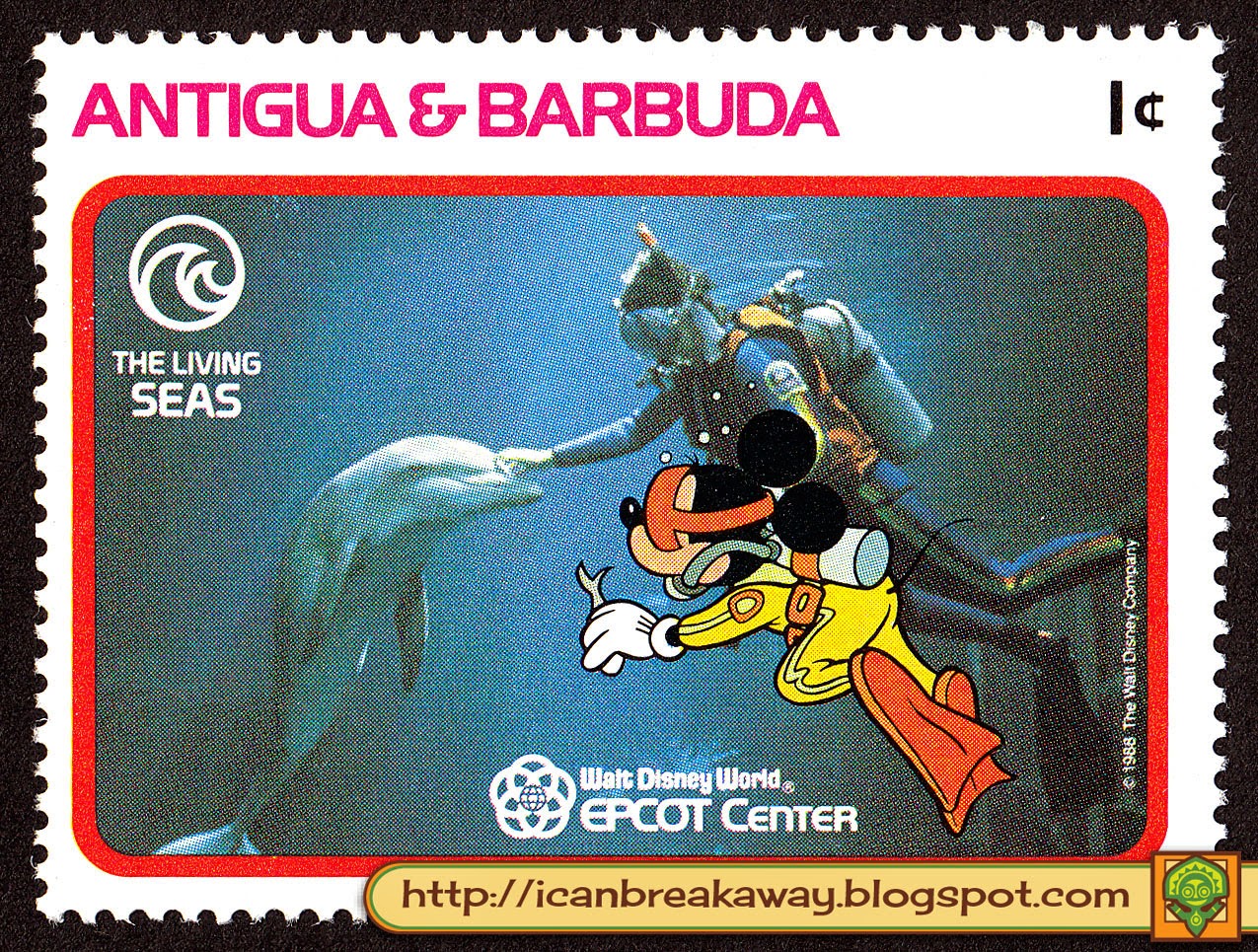
The second stand-out was a series of stamps focused on the original attractions found in the Future World section of Walt Disney World's EPCOT Center—the images immediately stood out in that they were the only stamps in the envelope to feature a theme park setting and the only designs to utilized character art with actual photographs. The EPCOT Center stamps were issued in the Eastern Caribbean dual-island state of Antigua and Barbuda in 1988.

Here are nice-quality scans of the six EPCOT Center stamps found within (click on each to enlarge)—the designers used the space nicely, fitting in not only the original EPCOT Center logo, but the icons and titles for each individual pavilion!

Spaceship Earth Stamp
Stamp Art © Disney

Universe of Energy Stamp
Stamp Art © Disney

World of Motion Stamp
Stamp Art © Disney

The Living Seas Stamp
Stamp Art © Disney

 The Land Stamp
Stamp Art © Disney

Journey Into Imagination Stamp
Stamp Art © Disney

Upon posting a quick photo of one of the stamps, Twitter user @MrProjectionist pointed out a link to Ken Polsson's comprehensive site, providing a small JPEG mosaic of the entire series (see image below). Interestingly, several images were repeated for higher postage rates... and the $5.00 stamp actually depicts a traveling Mickey Mouse heading towards the Contemporary Resort* six miles north of EPCOT Center!

The Entire 1988 Antigua and Barbuda EPCOT Center Series of Stamps
Screengrab From Topics on Stamps

Should I come across the remaining four stamps in the series offered for sale, I'll scan and add them in as an addendum. In the meantime, I'd like to welcome new visitors who arrived via The Season Pass Podcast. I Can Break Away is a co-sponsor of their most recent episode #292, the subject of which is sure to please fans of theme parks and EPCOT Center in particular: Part IV an exclusive interview with Walt Disney Imagineering's Tony Baxter.

Enjoy an Intelligent and Informative 4-Part Interview with Tony Baxter via The Season Pass Podcast
Image © & Courtesy of Disney Insider

You can listen to the new episode directly on the TSPP website HERE or subscribe via iTunes. The hosts are cordial and honest while covering a wide range of topics from all levels: creative, executive, and in-park employees. The full four-part interview with Tony Baxter can downloaded in the following episode links:


As I mentioned, episode #292 was co-sponsored by myself and another sponsor which deserves a look: the O-Zell Soda Company, which produces delicious natural sodas with a twist of real Walt Disney history! Please visit the link to their site and support The Walt Disney Birthplace Project in Chicago, IL: O-Zell Soda Company

Hey, Even Tony likes O-Zell!
Image © & Courtesy of O-Zell
* For our Walt Disney comic book sleuths: I believe that Contemporary Resort Mickey looks very much like he was drawn by Italian comic book legend Romano Scarpa. Thoughts?

Wednesday, April 10, 2013

The Business of Western Publishing's Disneyland Comic Books—Part II: Post-Disneyland, Inc. & Walt Disney World

Cover Art for Gold Key's Walt Disney Comics Digest #32
(October 1971)
© Disney

In the previous post on Western Publishing’s Disneyland-themed comic books, we concluded with Walt Disney Productions buying back Western’s share of the theme park from the Disneyland, Inc. venture. But the story doesn’t quite end in 1960—Western continued their license to publish Walt Disney comic books until 1984. Many changes took place in those intervening years of 1960 to 1984: not long after the era of the Dell Giants faded away, so too did the Four Color series, as Western chose a new direction with their comic book licenses. With that, their efforts took a noticeable shift in design and content. But Western wasn't quite done with theme park-centric comics...


Western's Family of Licenses Were Pulled From Dell Publishing to
Establish the In-House Gold Key Comics Imprint

The changes that took place were certainly motivated in part by the influx of cash to Western from the Disneyland, Inc. buyout at the start of the 1960s. Another factor was the huge profits pouring in as a result of gaining the publishing rights to the popular and wide variety of properties from the new television animation studio Hanna-Barbera. These parallel circumstances provided Western with both financial and bargaining clout during contract re-negotiations with Dell Publishing. The specific details of the split are unknown, as business records of their negotiations have been lost to time, but Western's leverage powered a decision to make a bold maneuver. Western would terminate their decades-old financing and distribution agreement with Dell at the end of the current contract. By the summer of 1962, Western pulled the majority of both their licensed and original material comic book lines from Dell and transitioned the titles to a new, in-house comics imprint: Gold Key comics.


The Conversion of Comic Titles From Dell to Gold Key
Made For a Strikingly Different Design Aesthetic
Cover Art © Disney

The sudden switch-over of well-known titles from Dell compelled Western to make Gold Key comics stand out on the racks for consumers—which they certainly did. Editors and artists percolated some wild design experiments with post-modern graphic and title treatments (sometimes within the comic stories themselves), plus more painted covers for standard titles, as well as testing other formats of comics. One format that found their way back into the mix were 80 page specials, including the popular annual holiday title Walt Disney's Christmas Parade.


Gold Key's Inaugural Issues Broke From Standard Design Conventions,
Introducing Vivid Colors, Outline-Free Borders and Angular Captions
From Hanna-Barbera Band-Wagon #1, Art by John Carey
© Hanna-Barbera, Image Courtesy of Saved From the Paper Drive

By 1960, Disneyland was a globally recognized name, and any comic book promoting the park was extra frosting on an already exquisite cake. Since Western no longer had a financial stake in Disneyland, there wasn't a huge priority to put together a new comic book that promoted the park. Nor was it deemed necessary to pull from their resources of artists and writers working on comic adaptions promoting Walt Disney's newest animated fare such as Professor Ludwig Von Drake or characters from features like The Sword in the Stone.

Western did continue providing promotional material and simpler-to-produce items for Disneyland through their Whitman line, especially games, puzzles and coloring/activity books.

Western Publishing's Whitman Division Produced a Commemorative
Coloring Book Celebrating Disneyland's 10th Anniversary in 1965
Cover Art © Disney, Image Courtesy of Disney History Institute


That's not to say Gold Key didn't pay the park any respect on its 10th Anniversary...

Front Cover to Gold Key's
Disneyland Special: Walt Disney's Vacation in Disneyland
84 Page Giant Comic (March/May 1965)
© Disney, Image Courtesy of  Comic Connect

The cover art shown above may look familiar to readers of the previous post. To the collector or purist, the interior contents and back cover will look familiar, too. This 80 page Gold Key special was a throwback to the Dell Giant format, but composed as something of a "Frankenstein's Monster"—the front cover reproduces the cover of Dell Giant Walt Disney's Vacation in Disneyland #1 (1958), the back cover is a reproduction of the back cover of Dell Giant Walt Disney's Donald Duck in Disneyland #1 (1955) and the book interior reprints the contents of Dell Giant #30: Walt Disney's Disneyland U.S.A. (1960).

The Back Cover Illustration of the 1965 Gold Key Disneyland Special
Was a Direct Reproduction of the Back Cover of the 1955 Dell Giant
Walt Disney's Donald Duck in Disneyland
© Disney, Image Courtesy of 2719 Hyperion

Therefore, no original artwork or stories were created for this special. Something not often considered during this era is the most unfortunate aspect of the topic at hand: the absence (and endless potential) of any new Disneyland-themed comic stories and art related to all the attractions added to the park during Walt Disney's creative explosion of the 1960s.*

The 1965 special was the last dedicated, stand-alone Disneyland-theme comic book Western produced. By the close of the decade, the comic book industry began to deal with a series of blows, the largest of which came by way of distribution: drugstores and newsstands were ordering less titles and/or lower quantities of comics. Since retailers received much higher profits from selling magazines with a cover price of 50¢–$2 than 12¢–15¢ comic books, simple business math dictated more money per month if magazines occupied valuable display space on their racks instead of comics books.

By the Mid-1960s, Drugstores and Newsstands Began to Reduce Space for
Comic Books to Accommodate Profitable, Higher-Priced Magazines
Image Courtesy of Detective27.com

This trend did not go unnoticed nor ignored by the major comic book companies. Marvel, DC, Archie, and Gold Key quickly reacted by:
  • raising cover prices on their standard comic books, and
  • introducing alternative formats in which to present and reprint their stories to make up the profits lost due to a shrinking marketplace.
In addition, Western condensed and cut back their regular titles. They had already been shrinking the page count of their Giant size specials incrementally through the 1960s, by the last few issues of the Gold Key iteration of Walt Disney's Christmas Parade, the annual lost it's heavy card stock covers and had dwindled to a standard 36-page count. The days of 100-page Giant comics with original material were over—but as a result of the alternative formats experiments mentioned earlier, new and classic content found a new life, with the introduction of Walt Disney Comics Digest in May of 1968.


Cover Art for Gold Key's Walt Disney Comics Digest # 1
(May 1968)
© Disney

With a price point of 50¢ and the first few issues clocking in at a whopping 196 pages, the digest format proved a mighty solution to the problems of stocking and distribution: retailers wouldn't have as much of a problem ordering several copies of a 50¢ digest that earned higher returns and took less space to display. It also provided the perfect forum to recycle Western's nearly 30-year library of Walt Disney comic art, with a selection of newer 2-tier stories that took less time to produce. Even the contents of the Dell Giants found their way into the books in their entirety, including occasional reprints of the Disneyland specials.

The Generous Page Count of Walt Disney Comics Digest Enabled Western to
Reprint The Contents of the Earlier Dell Giants in Their Entirety
© Disney

Of course, by the close of the 1960s, Walt Disney Productions had experienced some significant achievements: The Wonderful World of Color garnered excellent ratings on NBC, Mary Poppins became their biggest hit of all-time in 1964, their involvement in the 1964-65 New York World's Fair was lauded for technical entertainment innovations and Disneyland was going strong, adding some of the most memorable attractions in the park's history. Walt Disney was fortunate enough to witness all of this before he passed away in December of 1966. Before he left this world, Walt left behind the infrastructure to begin a new enterprise on the east coast, which became the Walt Disney World Resort in central Florida: formally named so and brought to fruition by his older brother, Roy O. Disney (the business half of Walt Disney Productions.)


Walt and Roy Disney Flank Governor Haydon Burns at the Famous
November 15, 1965 Press Conference Announcing Walt's "Florida Project"
Image Courtesy of Florida Memory

The scale and construction of the east coast resort was a bigger affair than the original shareholders of Disneyland, Inc. could fund, but by the time the first phase was open in October of 1971, Western Publishing did their part in providing the usual selection of Golden Books, sticker/coloring books, puzzles and activity kits that promoted the brand-new Walt Disney World Resort.

Western Publishing Prepared New Promotional Merchandise for the Launch of
Walt Disney World in 1971, Just as They Had for Disneyland in 1955
Cover Art © Disney

This time around, there was no giant comic book to commemorate the opening of the enormous theme park and hotel complex. But if you've made it this far, you can probably guess there was a logical comic book showcase for Western to promote Walt Disney World that autumn...

 
Table of Contents for Walt Disney Comics Digest #32
Cover Art © Disney

The layout and attraction line-up of Walt Disney World's Magic Kingdom were similar to Disneyland's, with the differences existing between facades and icons (e.g. Florida's towering Cinderella's Castle and Liberty Square area) and a handful of new attractions such as The Country Bear Jamboree. Western picked up on both aspects and again "Frankensteined" a portion of the special issue using several earlier Dell Disneyland stories for the identically themed areas such as Fantasyland, Aventureland and Tomorrowland. The framing device also took it's cue from the Disneyland-themed Dell Giants, with a framework of introductory panels showing Walt Disney characters arriving to visit the new park.

New Artwork Framed Stories in the Special Issue,
Titled The Magic Kingdom of Walt Disney World
From Walt Disney Comics Digest #32, © Disney

This time around, however, Western took the initiative to create some new content focusing on the unique architecture in the splash pages framing the stories centering on the new icons of the Resort:

Main Street U.S.A. Introduction Page
From Walt Disney Comics Digest #32, © Disney


 Adventureland Introduction Page
From Walt Disney Comics Digest #32, © Disney


Frontierland Introduction Page
From Walt Disney Comics Digest #32, © Disney


 Liberty Square Introduction Page
From Walt Disney Comics Digest #32, © Disney


Fantasyland Introduction Page
From Walt Disney Comics Digest #32, © Disney


 Tomorrowland Introduction Page
From Walt Disney Comics Digest #32, © Disney

It should be noted that the character art and the landscapes on these introduction splash panels are by the hands of at least two separate artists. Tony Strobl provided most of the pencil drawings (and possibly inks) for the character art, but the the surrounding settings were likely drafted by a Western/Gold Key artist adept to adventure or live-action based comics, perhaps Dan Spiegle or Alberto Giolitti. There were also several new and reprinted full-page games and puzzles, including this word game featuring Br'er Rabbit and the Florida-specific Haunted Mansion:

 Haunted Mansion Spookeroo Puzzle
From Walt Disney Comics Digest #32, © Disney


The framing panels aside, there were also two ORIGINAL stories for two of the themed lands in the new Magic Kingdom. A brand new, 11-page Main Street U.S.A. tale by Pete Alvarado in which Scrooge McDuck expresses a desire to travel back to the actual turn of the century (where prices are more acceptable)—his wish is helped along by a gadget from Ludwig Von Drake.

The other new tale is a 19-page Frontierland story, also by Pete Alvarado. Mickey Mouse and Donald Duck head to Grizzly Hall to view a performance of the new Country Bear Jamboree: Henry, Big Al, Trixie and the cast of the new audio-animatronic show make their first (and ONLY) comic book appearance.

The Frontierland/Country Bears Story Explodes the
Myth of Melvin the Mounted Moose!

Art by Pete Alvarado 
From Walt Disney Comics Digest #32, © Disney

Mouse and Duck assist in an Old West-style chase with some nods to Mike Fink and Davy Crockett. The Bears are well-depicted in character, as guests know them from the original show. But you can see for yourself: the text below is a link to a downloadable PDF of the entire Country Bears/Frontierland story. I don't believe this story has been reprinted anywhere since 1971! The file is about 12MB, so make sure you have a steady connection.


There's actually more to come on this subject beyond the 1970s... stay tuned! In the meantime, this series has a slight detour in the timeline between Parts 1 and 2. Click the link below to read Part 1.5, to gain some more insight on the initial impact of theme parks in the mid-20th Century, early days at Disneyland, and how it all looked through the lens of The Duck Man himself:


* The last two Disneyland comic books to hit the stands were Dell Four Color #1025: Walt Disney's Vacation in Disneyland (August/October 1959) and Dell Giant #30: Walt Disney's Disneyland U.S.A. (April/June 1960), both of which featured stories and cover art that prominently highlighted the first significant additions to Disneyland at the time of their debut: the Disneyland/Alweg Monorail, the Matterhorn Bobsleds and the Submarine Voyage Through Liquid Space. Had Walt Disney Productions repurchased the shares from Western a few years later, it is very likely comic readers of the 1960s would have enjoyed comic book tales of the Enchanted Tiki Room, Pirates of the Caribbean, and Adventure Through Inner Space written and drawn by some of the great comic artists of the time.

Thursday, November 29, 2012

A Rare Citrus Treat

The Orange Bird
Illustration by Dan Cunningham, © Disney
Medium: Vector Art in Adobe Illustrator

When Walt Disney World opened in late 1971, the resort could claim many unique features—most notably in the categories of size, transportation and recreational offerings compared to the original Disneyland in Anaheim, CA.

Florida Residents and Tourists Could Preview a Detailed Scale Model of the Walt Disney World Resort Prior to the October 1971 Opening
Image © & courtesy of Flickr user BestofWDW

However, much of the content within the theme park was a reflection of those found in Anaheim. The initial plan was for Walt Disney World's Magic Kingdom to feature a similar layout to Disneyland, debuting new, different attractions mixed with a selection of shared ones. During construction, time and budget crunches weakened the brew, leaving Florida only a handful of unique attraction offerings.


A Preoccupied Hollywood Legend Debates Original Attractions vs. Clones While Surveying Construction Progress
Image © & courtesy of Flickr user BestofWDW

Over the decades, with the global sprawl of Disney's domestic and international theme parks, a homogenization of elements became de rigueur. This, plus the accumulated experience of customer trends and market research aided a justification for overall consistency with fewer touches proprietary to a single area.

What marketing surveys and polls can't always nail is the nostalgia factor. User-controlled media the likes of fanzines, message boards, podcasts and blogs wield the ability to raise eyebrows and awareness of even the most trend-savvy analysts. It is largely due to the breadth of the internet that some things, deemed worthless, regain their capitalization potential and find their way back into the public consciousness.

 Demographic Surveys Rarely Factor in Kitsch or Nostalgia
Image courtesy of snapsurveys.com

Those of us who watched television commercials and spent time at Walt Disney World during the 1970s have recently been reunited with a familiar friend. Spring 2012 restored a seemingly simple and largely forgotten icon from the tangerine-hued ether, as the Florida Orange Bird resumed his place behind the Magic Kingdom's Sunshine Tree Terrace snack counter.


Over 25 Years Later, The Orange Bird is Back Where He Belongs
Image courtesy of Eating WDW Blog

Despite the burgeoning homogenization factor, the Orange Bird's restoration signaled an stabilizing modicum of individuality to Walt Disney World. He is one of the only unique icons of the resort's history: a distinct identity that was never copied anywhere else.

Beyond being represented on a sampling of new merchandise, the loveable avian/citrus hybrid adorns a large attraction poster under a main entrance tunnel into the park, and atop the "throwback" marquee, with proper font restored in place of the prior (and rather generic) interim typeface.


A Visual History of The Sunshine Tree Terrace Marquee
© Disney

The cost and effort behind the return of something as unremarkable as a long-discontinued, 40-year old Florida Citrus Commission mascot speaks volumes on the impact of user-based media. Minus the online recognition by those who simply remembered the character fondly, the formal reestablishment of The Orange Bird at Walt Disney World would never have surfaced*.

I won't go into a great deal of background on the character here, as there have been a multitude of resources online over the past few years chronicling the Bird's history and return. The most notable and informative of these you can discover in the following links:

Widen Your World was the first website to provide a solid, well-researched overall history of the character:

Jim Korkis, Disney Historian and author of the excellent The Vault of Walt and Who's Afraid of Song of the South & Other Forbidden Disney Stories, placed his research efforts and eye for detail on the Bird's notoriety with three posts, spanning five years via MousePlanet:

Mr. Korkis has also put up another post at Jerry Beck's Cartoon Research site, with information on the Bird's singular animated short film Foods and Fun: A Nutrition Adventure for Walt Disney Educational Media, produced by Rick Reinert Productions (including a full video of the short):

The eloquent Michael Crawford at Progress City U.S.A. provides further history with a thoughtful essay on the impact of the character's relationship to Walt Disney World during the resort's challenging early years**:

FoxxFurr's Passport to Dreams Old and New covers more in-depth history and provides intelligent insight on the practical character design aspects, and the character's overall aesthetic appeal upon the 2012 return of The Orange Bird:

Over at Miehana, the talented Kevin Kidney briefly recounts his participation in uncovering the hidden location and restoration of the original Orange Bird figurine, and a good look at the improved paint finishing bestowed upon it:

My own early online efforts were on display in 2007, when I created custom desktop wallpaper for Jeff Pepper's exemplary 2719 Hyperion blog:

A Rare AUDIO Citrus Treat


 Magical Memories Magazine #1
The Premiere Issue of Jesse Guiher's Audio Fanzine, Photo © by Dan Cunningham

Nearly a decade ago, I was fortunate enough to purchase a rare gem of the aforementioned user-based media. At that time, a search on the subject of The Orange Bird garnered scant results, save for a few crumbs of information and a heaping teaspoon of items on eBay. One afternoon, I noticed a message board posting with an ad for the premiere issue of Magical Memories Magazine, an audio fanzine consisting of 2 CDs with narrated content about a particular theme park attraction. Here was user-based audio which predated the podcast explosion to come, about a year later. MMM #1 was themed to The Enchanted Tiki Room of Disneyland (Disc 1) and Walt Disney World (Disc 2), with ornate packaging and inserts.


MMM #1 Was a Feast of Visual & Audio Ephemera
Photo © by Dan Cunningham

The 'zine did not feature attraction audio, opting for original content: in-depth history on the mid-century tiki craze, stories and recollections from those who'd worked and maintained The Enchanted Tiki Room on both coasts, an exclusive interview with Disney Legend X. Atencio, and... a thirteen-minute audio history of The Florida Orange Bird.

All this was constructed and offered by a gentleman named Jesse Guiher: an ambitious Oregon-based artist and designer. I contacted Jesse earlier this year, and got a bit of background on the history of his Magical Memories Magazine project (two other issues followed before he ceased production, MMM #2 focused on the Disneyland Haunted Mansion Holiday overlay, and MMM #3 looked at the myriad attractions inspired by 20,000 Leagues Under the Sea).
"I only had one other person to help with the 'zine, so it was a long, laborious process to do each issue, as I did everything from interviews to editing to graphic design and art, it was a lot of fun but such a great deal of work that I didn't have time for anything else. [I]ronically, it was the beginnings of success that killed the 'zine: I couldn't fulfill the orders fast enough [or] on time, once they started pouring in on the third issue."
– Jesse Guiher, May 2012
Jesse also very generously gave me permission to post the long out-of-circulation Orange Bird History audio (note: history covers the years 1970–2004) here for everyone to enjoy. All participants on MMM #1 used pseudonyms, with the exception of Jesse himself, who took on the role of host and interviewer throughout the 'zine. The author and narrator of The Orange Bird History audio is known as "Howard"—hit the play button to listen right here:


Or download the MP3 HERE

Jesse is currently working on a new kids noir web comic, and you can see samples of his artwork over at TigerTailArt—make sure you tell him thanks for sharing! 
* To be fair, the only other potential factor was a merchandise push of the character in the early 2000s to Japanese consumers (be sure to read the Widen Your World article for details.)
** Crawford's post speaks of the loss of the character: his post was published in November 2011, unknowingly foreshadowing the Bird's return to the Sunshine Tree Terrace in April 2012.