Showing posts with label Art. Show all posts

Monday, February 3, 2014

Playlist: Songs of Hawaii (Winter 2014 Edition)


Aloha ʻOe!
Splash Panel Detail from "The Menehune Mystery"
From Uncle Scrooge #4 (December 1953)
Story and Art by Carl Barks
© Disney

Aloha, and welcome back for the first post in quite a few weeks! Much of the U.S. has been caught up in a icy start to 2014—here in the northeast, a weather system known as the polar vortex welcomed in the new year. It continues to repeat, leaving most of us pining for warmer climes. During cold spells like this, sun-kissed, far-away places like the Hawaiian Islands seem farther away than ever. So what's the best way to combat freezing temperatures? Bundle up and let some music take you away to somewhere warmer...

The Scenic View Off Oahu's Kailua Beach Park
Image © by Dan Cunningham

If you've visited or have even the most basic knowledge of the 50th state, it's easy to understand Hawaii offers much to please all five senses: unique views, scents and flavors are revealed around every turn. Native Hawaiian culture trumps or intertwines much of the urban influence from the mainland, and even the pace maintains a distinct tempo. This is especially evident in the music that originates from the islands, which is the very subject of this season's playlist suggestions.

Front Entrance to the Dole Pineapple Plantation in Wahiawa, HI
Image © by Dan Cunningham

Whether you're shopping, strolling, or driving, it's hard to avoid slack-key guitar music on a visit to any of the Hawaiian islands. Even the train tour at the famous Dole Pineapple Plantation plays a lighthearted recording of slack-key guitar as the miniature train trundles along past pungent, never-ending fields of pineapple plants.

Tuning Into Slack-Key Guitar

Modern-Day Hawaiian Slack-Key Masters,
George Kahumoku, Jr. and Ledward Kaapana
Image © & Courtesy of slackkey.net

Sometimes peppy, sometimes dreamy, slack-key is a fingerstyle of guitar playing, with one or more of the tuning keys loosened to create the sound that unmistakably represents and identifies Hawaiian culture. The practice goes back to the early 19th century, when Spaniards passing through Hawaii taught the slack-key technique during their visit, letting the Hawaiian people practice and re-develop the technique. Slack-key style combined with steel guitar and the iconic ukelele provide the signature sounds of Hawaiian music.

"The Three Bears" Waterfall on Maui's Historic Road to Hana 
Image © by Dan Cunningham

The local music matches the beauty and tranquility of the land: from bustling Waikiki, to the rustic roads of Maui, to the varied terrains of the Big Island, to the wild rainforests of Kauai.

Music and Cocktails Go Together

While there is plenty of variety to Hawaiian music, the songs suggested here are some of the most well-known, and intended to set a mood—in a few months, we'll visit Polynesian music with a more expansive theme of the exotic South Seas to suit the setting of a classic mid-century Tiki bar. That's not to say we can't prepare a nice tropical drink to enjoy with the music before then. Here's a simple and delicious recipe:

Let's Have a Drink With Shag
Card & Design © Joshua "Shag" Agle

Joshua "Shag" Agle has done his part to re-introduce Tiki culture into the 21st century. His appealing paintings and illustrations restore the hip, mid-century lounge scene with bright, vibrant colors and a design sense that evokes that era, yet is fully functional in the current day.

The drink featured comes from a beautifully illustrated package of cards called "Shag's Tiki Drinks Deck: 52 Ways to Shake Your Way to Paradise"the card set sold out long ago, but a Google search might uncover a set for your own home bar set-up. Click the link below to search:


 TAHITIAN TATTOO Preparation
Card & Design © Joshua "Shag" Agle

Even though we're not talking Tahiti this time, it's a relatively close neighbor. The ingredients needed are exemplary of Hawaiian flavors and easily attainable, making the Tahitian Tattoo is a pretty simple drink to prepare. It might just make you forget the cold winter months for a while.

Click the recipe card on the right
to enlarge and print at your convenience:


With the libations taken care of, let's have some music...

    Album Art for Winter 2014 Playlist—Songs of Hawaii

To transition us from the mainland and the recent posts on Walt Disney Productions, Annette Funicello eases our journey west with the catchy "(Every Night is) Date Night in Hawaii"—a melody which will stay with you forever, even after a single play. From there we go straight to Hawaii with the New Hawaiian Band, get a quick lesson in the local language from Martin Pahinui & Co., then a song from Israel "IZ" Kamakawiwo'ole, a unique voice who left this world far too young, and far too soon. Then there's a perfect example of slack-key guitar from Ken Emerson, and Don Ho, of course... it's NOT "Tiny Bubbles" (but a classic nonetheless!) Martin Denny's rich studio recording of "Hawaiian War Chant" swings us back east 'round Hollywood way. The musical arrangements of Martin Denny will be featured in an upcoming post later this year.

Sam Ku West is Considered One of the Best Steel Guitar Players of All Time
Image © & Courtesy of Brad's Page of Steel

As usual, there's a FREE MP3 to get your playlist started, this time it features a vintage recording of a Hawaiian steel guitar from one of the pioneers of the format: Sam Ku West. Few recordings exist of West's performances, so this is something of a rare treat, courtesy of archive.org

You'll find the free MP3 by Sam Ku West below the list of the eight song suggestions. As usual, direct links to albums for both stores are provided below the description of each song, where you can listen to audio samples and purchase those that you might want to use to create your own Hawaiian-inspired playlist. Remember: I don't get a piece of the profits if you make a purchasethe links are there to make things easy.

(Every Night is) Date Night in Hawaii
Artist: Annette Funicello
Album: Hawaiiannette
Amazon  |  iTunes

On the Beach at Waikiki
Artist: New Hawaiian Band
Album: New Hawaiian Band: Hawaii's Greatest Hits, Vol. 1
Amazon  |  iTunes 
 
C-A-T, Pöpoki Spells Cat
Artists: Aaron Mahi, Bobby Ingano, George Kuo & Martin Pahinui
Album: Ho'olohe [Listen]
Amazon  |  iTunes 

Henehene Kou 'Aka
Artist: Israel "IZ" Kamakawiwo'ole
Album: Facing Future
Amazon  |  iTunes 

Miloli'i Slack Key
Artist: Ken Emerson
Album: Slack Key Guitar
Amazon  |  iTunes 

White Ginger Blossoms
Artist: Haunani Kahalewai
Album: Hawaii... A Musical Memento of the Islands
Amazon  |  iTunes 

The Hukilau Song
Artist: Don Ho
Album: Don Ho—Hawaii's Ambassador of Aloha to the World
Amazon  |  iTunes 

Hawaiian War Chant
Artist: Martin Denny
Album: Quiet Village
Amazon  |  iTunes 

Sunkist Hawaii
Artist: Sam Ku West and The Harmony Boys
(Recorded March 26, 1928)
CLICK HERE FOR FREE MP3 DOWNLOAD

On Island Life, Even Familiar Icons Adopt a Hawaiian Identity

Friday, September 20, 2013

A "Frozen" Rita?

A 1998 Sample of My College Newspaper Comic Strip Bill & Rita
© 2013 by Dan Cunningham

Frequent readers of this blog likely observe a distance from an editorial directionnor does I Can Break Away maintain much account of personal life beyond presenting original artwork, or minor anecdotes on the topic at hand. This post will place itself somewhere in the middle of that framework, due to the tenuous connection of the subjects in this post.

One-Sheet Teaser Poster for Walt Disney Animation's Upcoming Feature Frozen
Image Courtesy of moviepilot.com
© Disney

Initial marketing and advertising campaign has commenced for the forthcoming animated feature Frozen from the Walt Disney Animation Studio (slated for U.S. release on Thanksgiving week of 2013.) Having witnessed Frozen preliminary art and teaser trailers that trickled out over the course of the summer, I was impressed with the scope and charm of the animated film, but never lingered enough to take a good look at the design of one of the lead characters until about a week ago.

 One-Sheet Poster of Elsa the Snow Queen From Frozen
Image Courtesy of fanpop.com
© Disney

An online image of Frozen poster art centered on one of the female lead characters stopped me in my tracks. I recognized a design I quite liked, for reasons I wasn't sure of. It soon hit me that Elsa the Snow Queen looked remarkably familiar to something linked to my own past...

A Good Look at Elsa From Frozen Sparked Warm Memories of Rita

Can you can see why? Not just in the design of an attractive girl, but the hairstyle? Minus the braid, Elsa bears a striking resemblance to the female lead character of my own Bill & Rita. Of course, this is a coincidence of design choice, not a "lift" by anyone at Disney Animation.

In fact, that's downright impossible: each Bill & Rita strip was only published oncewell over a decade ago to a tiny audience, via a minimal-circulation campus newspaper. Nor has it had a public presentation since. But seeing Elsa inspired me to share a bit about the conception of the strip, and some thoughts about character design in general.

Who Are Bill and Rita?

In 1996, a decision was made to transition from art school to complete my college education at an actual University. The timing would be my only opportunity to do so at an appropriate age: continuing an art degree by way of broadening my academic horizons and more intellectual pursuits. The bohemian atmosphere of an art-focused college was unique, but couldn't replicate the experience of large ivy-covered halls, school Football games, or the opportunity to get involved in a college newspaper.

Bill & Rita Appeared in C.W. Post's Student Newspaper, The Pioneer From Fall 1996 to Spring 1998

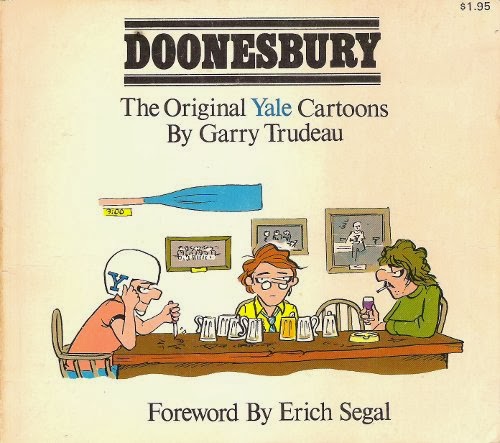
Orientation day at Long Island University's C.W. Post campus found me leaving a message in the mailbox of the Editor of their campus newspaper The Pioneer, requesting a meeting to discuss providing some kind of comic art on a bi-weekly basis. My request was received with success, and I was given carte blanche on the subject of a traditional, four-panel comic strip. My notion was that, naturally, college students would be be most interested in reading  about college students. But satire on college life featuring a bunch of eighteen-to-twenty-somethings seemed like the type of thing that's been done in a lot in college newspapers (most notably Garry Trudeau's Doonesbury predecessor Bull Tales at Yale and Jeff Shesol's Thatch at Brown University.) 

Garry Trudeau's Doonesbury Began Life at Yale as Bull Tales
Image Courtesy of The Hipster Dad Bookshelf 
 © 2013 G.B. Trudeau

The concept that I decided on was a campus setting surrounding new characters, incorporating an anthropomorphic dog character named Bill, intended for another comic strip idea. A few years before "prequel" became a part of the pop culture lexicon, I slimmed down his appearance and dialed back the dog's age to be college appropriate, keeping the forthcoming timeline of the intended later comic strip intact.

Bill, My Faithful Canine Character Became An Unlikely, But Loveable Lead For a College-Centered Comic Strip
© 2013 by Dan Cunningham

Now I had an upbeat, cute, talking animal character and some yet-to-be conceived twenty-somethings. Why not give more texture to the thing and make one of them Bill's human girlfriend? If the species thing isn't the one-note joke every week, there could be comedic conflict there. So Rita was conceived as Bill's significant other.

I Used Them With RestraintBut When You Set Up a Premise Like This, Species Compatibility Gags Are Inevitable!
© 2013 by Dan Cunningham

What Kind of Girl Dates a Dog?

From the start, I knew Rita shouldn't be too prissy, nor overly brusqueshe had to be a strong, wise girl coming of age in the 1990s. She also had to be open-minded enough to date a talking dog (which wasn't necessarily a new idea: Berke Breathed's Opus the penguin frequently dated human females in Bloom County, and we all know Gary K. Wolf's Roger Rabbit married the buxom, human Jessica Rabbit.) But Bill and Rita's personal dynamic and campus life would be the focus of the strip.

 Despite The Many Odds Against Them, It Had To Be Clear Bill and Rita Genuinely Adored Each Other
© 2013 by Dan Cunningham

Knowing that much about who she needed to be, Rita's design process was based on an technique long-used by professional cartoonist and animation artists: the "silhouette test" which is used in two capacities:

To enable a character with designs rendering their contour shape recognizable, even in silhouette...

Instantly Recognizable and Clearly Defined Silhouettes of Famous Cartoon Characters
Image Courtesy of Frederator Studios

... and establish poses clear enough that a character's action is readable.

 Figure A Shows Jiminy's Action Clearly, and Reads Better as Both a Standard Line Drawing and in Silhouette
Image Courtesy of Animator Mag Library
© Disney

Using this method led to Rita's slim frame, shorter hairstyle, and the up-lifted spit curl at the center of her hairline. She'd stand out as female in silhouette, but slightly askew of more fashionable girls her age. Though the strips never appeared in color, Rita's hair is platinum/bleach blonde to the point of pure white with the slightest tint of pale yellowin my mind, it set Rita further apart from her peers as a level-headed, but quiet, rebel. This design process helped define her personality, before any actual writing began.
 

An Early Strip From 1996 Shows Easy-to-Read Profiles of the Main Characters (Preceding a Slow Climb Towards Better Drafting, Steadier Line Art and Clear Hand-Lettering)
© 2013 by Dan Cunningham

Bill & Rita was an early effort on my part, and the early strips are hard to look at without extreme scrutiny, despite the strong personalities of the characters. However, as each strip progressed, I figured out more about using a nib pen with a jar of Windsor-Newton ink, attempting clearer hand-lettering, placement of line weights and trying zipatone screens. By 1997, things became more polished and proved true the advice of Charles M. Schulz on starting a new comic feature: "Draw fifty strips, throw them away, and then start again."

Bill & Rita Today


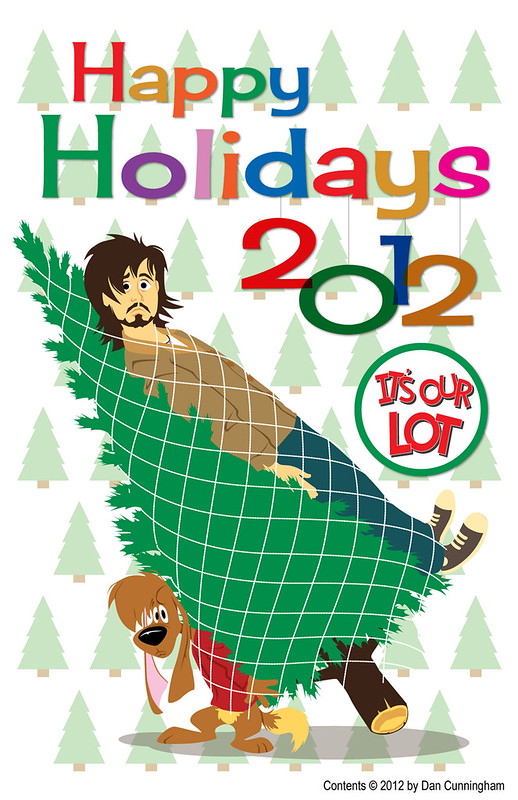
These Days, Bill Provides Hi-Jinks in My Annual Holiday Card (Along With the Slightly Less Hairy Chap Pictured Above)
© 2012 by Dan Cunningham 

Bill & Rita had a definitive conclusion once I received my diploma, and the artwork largely laid in a envelope as something of an afterthought as I quickly paved my way into the professional world of commercial art. Of course, the dog continues to play a role of canine mascot in my annual custom Holiday Card, and it's possible I'll post the entire college run of Bill & Rita here someday, most likely via a remarkable online book format recently directed to me by none other than renaissance man and friend of the blog, Joseph Cowles.

Beyond revisiting the original strips, there may be a future for the cast of Bill & Rita: for once their personalities and relationships solidified, I found they often wrote themselves. I've sporadically toyed with the idea of a new graphic novel in strip format:

 Thumbnail Concepts For a New, Book-Length Story: Bill & Rita in Abnormal Spring Formal
© 2013 by Dan Cunningham 

Should such a project come to pass, you'll certainly hear about it here. For the record, I'd still place it in those years of the mid-1990s, the final era to depict college life before technology commanded primary social interactions. All done with a promise of much-improved artwork/drafting, and the benefit of color.

Wednesday, April 10, 2013

The Business of Western Publishing's Disneyland Comic Books—Part II: Post-Disneyland, Inc. & Walt Disney World

Cover Art for Gold Key's Walt Disney Comics Digest #32
(October 1971)
© Disney

In the previous post on Western Publishing’s Disneyland-themed comic books, we concluded with Walt Disney Productions buying back Western’s share of the theme park from the Disneyland, Inc. venture. But the story doesn’t quite end in 1960—Western continued their license to publish Walt Disney comic books until 1984. Many changes took place in those intervening years of 1960 to 1984: not long after the era of the Dell Giants faded away, so too did the Four Color series, as Western chose a new direction with their comic book licenses. With that, their efforts took a noticeable shift in design and content. But Western wasn't quite done with theme park-centric comics...


Western's Family of Licenses Were Pulled From Dell Publishing to
Establish the In-House Gold Key Comics Imprint

The changes that took place were certainly motivated in part by the influx of cash to Western from the Disneyland, Inc. buyout at the start of the 1960s. Another factor was the huge profits pouring in as a result of gaining the publishing rights to the popular and wide variety of properties from the new television animation studio Hanna-Barbera. These parallel circumstances provided Western with both financial and bargaining clout during contract re-negotiations with Dell Publishing. The specific details of the split are unknown, as business records of their negotiations have been lost to time, but Western's leverage powered a decision to make a bold maneuver. Western would terminate their decades-old financing and distribution agreement with Dell at the end of the current contract. By the summer of 1962, Western pulled the majority of both their licensed and original material comic book lines from Dell and transitioned the titles to a new, in-house comics imprint: Gold Key comics.


The Conversion of Comic Titles From Dell to Gold Key
Made For a Strikingly Different Design Aesthetic
Cover Art © Disney

The sudden switch-over of well-known titles from Dell compelled Western to make Gold Key comics stand out on the racks for consumers—which they certainly did. Editors and artists percolated some wild design experiments with post-modern graphic and title treatments (sometimes within the comic stories themselves), plus more painted covers for standard titles, as well as testing other formats of comics. One format that found their way back into the mix were 80 page specials, including the popular annual holiday title Walt Disney's Christmas Parade.


Gold Key's Inaugural Issues Broke From Standard Design Conventions,
Introducing Vivid Colors, Outline-Free Borders and Angular Captions
From Hanna-Barbera Band-Wagon #1, Art by John Carey
© Hanna-Barbera, Image Courtesy of Saved From the Paper Drive

By 1960, Disneyland was a globally recognized name, and any comic book promoting the park was extra frosting on an already exquisite cake. Since Western no longer had a financial stake in Disneyland, there wasn't a huge priority to put together a new comic book that promoted the park. Nor was it deemed necessary to pull from their resources of artists and writers working on comic adaptions promoting Walt Disney's newest animated fare such as Professor Ludwig Von Drake or characters from features like The Sword in the Stone.

Western did continue providing promotional material and simpler-to-produce items for Disneyland through their Whitman line, especially games, puzzles and coloring/activity books.

Western Publishing's Whitman Division Produced a Commemorative
Coloring Book Celebrating Disneyland's 10th Anniversary in 1965
Cover Art © Disney, Image Courtesy of Disney History Institute


That's not to say Gold Key didn't pay the park any respect on its 10th Anniversary...

Front Cover to Gold Key's
Disneyland Special: Walt Disney's Vacation in Disneyland
84 Page Giant Comic (March/May 1965)
© Disney, Image Courtesy of  Comic Connect

The cover art shown above may look familiar to readers of the previous post. To the collector or purist, the interior contents and back cover will look familiar, too. This 80 page Gold Key special was a throwback to the Dell Giant format, but composed as something of a "Frankenstein's Monster"—the front cover reproduces the cover of Dell Giant Walt Disney's Vacation in Disneyland #1 (1958), the back cover is a reproduction of the back cover of Dell Giant Walt Disney's Donald Duck in Disneyland #1 (1955) and the book interior reprints the contents of Dell Giant #30: Walt Disney's Disneyland U.S.A. (1960).

The Back Cover Illustration of the 1965 Gold Key Disneyland Special
Was a Direct Reproduction of the Back Cover of the 1955 Dell Giant
Walt Disney's Donald Duck in Disneyland
© Disney, Image Courtesy of 2719 Hyperion

Therefore, no original artwork or stories were created for this special. Something not often considered during this era is the most unfortunate aspect of the topic at hand: the absence (and endless potential) of any new Disneyland-themed comic stories and art related to all the attractions added to the park during Walt Disney's creative explosion of the 1960s.*

The 1965 special was the last dedicated, stand-alone Disneyland-theme comic book Western produced. By the close of the decade, the comic book industry began to deal with a series of blows, the largest of which came by way of distribution: drugstores and newsstands were ordering less titles and/or lower quantities of comics. Since retailers received much higher profits from selling magazines with a cover price of 50¢–$2 than 12¢–15¢ comic books, simple business math dictated more money per month if magazines occupied valuable display space on their racks instead of comics books.

By the Mid-1960s, Drugstores and Newsstands Began to Reduce Space for
Comic Books to Accommodate Profitable, Higher-Priced Magazines
Image Courtesy of Detective27.com

This trend did not go unnoticed nor ignored by the major comic book companies. Marvel, DC, Archie, and Gold Key quickly reacted by:
  • raising cover prices on their standard comic books, and
  • introducing alternative formats in which to present and reprint their stories to make up the profits lost due to a shrinking marketplace.
In addition, Western condensed and cut back their regular titles. They had already been shrinking the page count of their Giant size specials incrementally through the 1960s, by the last few issues of the Gold Key iteration of Walt Disney's Christmas Parade, the annual lost it's heavy card stock covers and had dwindled to a standard 36-page count. The days of 100-page Giant comics with original material were over—but as a result of the alternative formats experiments mentioned earlier, new and classic content found a new life, with the introduction of Walt Disney Comics Digest in May of 1968.


Cover Art for Gold Key's Walt Disney Comics Digest # 1
(May 1968)
© Disney

With a price point of 50¢ and the first few issues clocking in at a whopping 196 pages, the digest format proved a mighty solution to the problems of stocking and distribution: retailers wouldn't have as much of a problem ordering several copies of a 50¢ digest that earned higher returns and took less space to display. It also provided the perfect forum to recycle Western's nearly 30-year library of Walt Disney comic art, with a selection of newer 2-tier stories that took less time to produce. Even the contents of the Dell Giants found their way into the books in their entirety, including occasional reprints of the Disneyland specials.

The Generous Page Count of Walt Disney Comics Digest Enabled Western to
Reprint The Contents of the Earlier Dell Giants in Their Entirety
© Disney

Of course, by the close of the 1960s, Walt Disney Productions had experienced some significant achievements: The Wonderful World of Color garnered excellent ratings on NBC, Mary Poppins became their biggest hit of all-time in 1964, their involvement in the 1964-65 New York World's Fair was lauded for technical entertainment innovations and Disneyland was going strong, adding some of the most memorable attractions in the park's history. Walt Disney was fortunate enough to witness all of this before he passed away in December of 1966. Before he left this world, Walt left behind the infrastructure to begin a new enterprise on the east coast, which became the Walt Disney World Resort in central Florida: formally named so and brought to fruition by his older brother, Roy O. Disney (the business half of Walt Disney Productions.)


Walt and Roy Disney Flank Governor Haydon Burns at the Famous
November 15, 1965 Press Conference Announcing Walt's "Florida Project"
Image Courtesy of Florida Memory

The scale and construction of the east coast resort was a bigger affair than the original shareholders of Disneyland, Inc. could fund, but by the time the first phase was open in October of 1971, Western Publishing did their part in providing the usual selection of Golden Books, sticker/coloring books, puzzles and activity kits that promoted the brand-new Walt Disney World Resort.

Western Publishing Prepared New Promotional Merchandise for the Launch of
Walt Disney World in 1971, Just as They Had for Disneyland in 1955
Cover Art © Disney

This time around, there was no giant comic book to commemorate the opening of the enormous theme park and hotel complex. But if you've made it this far, you can probably guess there was a logical comic book showcase for Western to promote Walt Disney World that autumn...

 
Table of Contents for Walt Disney Comics Digest #32
Cover Art © Disney

The layout and attraction line-up of Walt Disney World's Magic Kingdom were similar to Disneyland's, with the differences existing between facades and icons (e.g. Florida's towering Cinderella's Castle and Liberty Square area) and a handful of new attractions such as The Country Bear Jamboree. Western picked up on both aspects and again "Frankensteined" a portion of the special issue using several earlier Dell Disneyland stories for the identically themed areas such as Fantasyland, Aventureland and Tomorrowland. The framing device also took it's cue from the Disneyland-themed Dell Giants, with a framework of introductory panels showing Walt Disney characters arriving to visit the new park.

New Artwork Framed Stories in the Special Issue,
Titled The Magic Kingdom of Walt Disney World
From Walt Disney Comics Digest #32, © Disney

This time around, however, Western took the initiative to create some new content focusing on the unique architecture in the splash pages framing the stories centering on the new icons of the Resort:

Main Street U.S.A. Introduction Page
From Walt Disney Comics Digest #32, © Disney


 Adventureland Introduction Page
From Walt Disney Comics Digest #32, © Disney


Frontierland Introduction Page
From Walt Disney Comics Digest #32, © Disney


 Liberty Square Introduction Page
From Walt Disney Comics Digest #32, © Disney


Fantasyland Introduction Page
From Walt Disney Comics Digest #32, © Disney


 Tomorrowland Introduction Page
From Walt Disney Comics Digest #32, © Disney

It should be noted that the character art and the landscapes on these introduction splash panels are by the hands of at least two separate artists. Tony Strobl provided most of the pencil drawings (and possibly inks) for the character art, but the the surrounding settings were likely drafted by a Western/Gold Key artist adept to adventure or live-action based comics, perhaps Dan Spiegle or Alberto Giolitti. There were also several new and reprinted full-page games and puzzles, including this word game featuring Br'er Rabbit and the Florida-specific Haunted Mansion:

 Haunted Mansion Spookeroo Puzzle
From Walt Disney Comics Digest #32, © Disney


The framing panels aside, there were also two ORIGINAL stories for two of the themed lands in the new Magic Kingdom. A brand new, 11-page Main Street U.S.A. tale by Pete Alvarado in which Scrooge McDuck expresses a desire to travel back to the actual turn of the century (where prices are more acceptable)his wish is helped along by a gadget from Ludwig Von Drake.

The other new tale is a 19-page Frontierland story, also by Pete Alvarado. Mickey Mouse and Donald Duck head to Grizzly Hall to view a performance of the new Country Bear Jamboree: Henry, Big Al, Trixie and the cast of the new audio-animatronic show make their first (and ONLY) comic book appearance.

The Frontierland/Country Bears Story Explodes the
Myth of Melvin the Mounted Moose!

Art by Pete Alvarado 
From Walt Disney Comics Digest #32, © Disney

Mouse and Duck assist in an Old West-style chase with some nods to Mike Fink and Davy Crockett. The Bears are well-depicted in character, as guests know them from the original show. But you can see for yourself: the text below is a link to a downloadable PDF of the entire Country Bears/Frontierland story. I don't believe this story has been reprinted anywhere since 1971! The file is about 12MB, so make sure you have a steady connection.


There's actually more to come on this subject beyond the 1970s... stay tuned! In the meantime, this series has a slight detour in the timeline between Parts 1 and 2. Click the link below to read Part 1.5, to gain some more insight on the initial impact of theme parks in the mid-20th Century, early days at Disneyland, and how it all looked through the lens of The Duck Man himself:


* The last two Disneyland comic books to hit the stands were Dell Four Color #1025: Walt Disney's Vacation in Disneyland (August/October 1959) and Dell Giant #30: Walt Disney's Disneyland U.S.A. (April/June 1960), both of which featured stories and cover art that prominently highlighted the first significant additions to Disneyland at the time of their debut: the Disneyland/Alweg Monorail, the Matterhorn Bobsleds and the Submarine Voyage Through Liquid Space. Had Walt Disney Productions repurchased the shares from Western a few years later, it is very likely comic readers of the 1960s would have enjoyed comic book tales of the Enchanted Tiki Room, Pirates of the Caribbean, and Adventure Through Inner Space written and drawn by some of the great comic artists of the time.