Showing posts with label Comic Strips. Show all posts

Monday, February 9, 2015

Playlist: Songs of Comic Strips

Newspaper Comic Strips Were Adapted Into Other Entertainment Media Such as Radio, Movies, Television and Records
Image Courtesy of Blaine's Puzzle Blog

This round of playlist suggestions has a set of rules: the songs are inspired by properties that began as comic strips. So any characters that originated in animation or comic books that were subsequently featured in comic strips (such as Felix the Cat, Mickey Mouse, Superman or Archie) are excluded! Sometime down the line, we'll shine a light on music inspired by comic book characters, and other variations… for today, let's get some printer's ink on our fingers.

There's Plenty of Links at the End of the Post to Start Up Your Own Comic Strip Playlist
Image Courtesy of Karl Tryggvason
Artwork by Charles M. Schulz
Peanuts © Peanuts Worldwide, LLC

I'm also happy to tell you that beyond the usual links to Amazon and iTunes albums, this playlist offers FOUR free MP3 downloads, with links to several more free tracks to get your own comic strip playlist going.

Sunday Funnies
During the 20th century, a significant highlight of the American weekend occurred each Sunday morning. Often procured by a trip to the corner drugstore as a thick bundle held snugly under the arm, or as a thunderous THUMP on the front porch. Either delivery method meant that much-anticipated token, the Sunday edition of the local newspaper, had arrived.

An Example of a 1939 Sunday Comics Page
Scan Courtesy of Animation Resources

Of all the expanded features within, the section ranking highest desirability was the large, full-color comic section. The Sunday comics were most often exposed as the front-facing layer cradling the bulky strata of the entire Sunday edition, like tempting and colorful Christmas wrapping paper. The Sunday comics were lovingly referred to early on as "The Funny Papers" or simply "The Funnies."

Government Worker Reads the Sunday Comics on the Back Porch at Arlington Farms, VA Residence for Women (1943)
Image Courtesy of History in Photos

It was here that the latest chapter of favorite serialized adventures such as Chester Gould's Dick Tracy and Milton Caniff's Terry and the Pirates were found, leaving another cliffhanger for next week's not-to-be-missed installment. Laughs could be had from Frank King's Gasoline Alley and Al Capp's Li'l Abner, while Walt Kelly's Pogo brought hilarious social and political through the eyes of the "critters" of Okefenokee Swamp.

Whether in crisp black and white daily strips or in full color on Sundays, it's easy to see why "The Funnies" became the most coveted section for every member of the household. This was an especially important (and affordable) diversion during the era of the Great Depression.

Appointment Reading
How popular were the continuing adventures of newspaper comics? A 1945 New York City newspaper delivery strike left readers and subscribers frustrated that their households were missing out on the latest installments of their favorite comic strips. So much so, that New York’s Mayor Fiorello LaGuardia solved the problem by reading the Sunday comics over the air during his weekly radio address. Thanks to the archives of WNYC public radio, here's a sample clip of the Mayor's July 8, 1945 broadcast:


Early Comic Strip Songs
From the early part of the 20th century, several comic strips had already stood out in popularity, and became vehicles for other media. Since radio was the most popular form of entertainment within the home, it was a natural conclusion to adapt comic strip characters into music and audio dramatizations.

"Barney Google (Foxtrot)" by Billy Rose Became the First Popular Song Based on a Comic Strip Property
Image Courtesy of museumofplay.org
© King Features Syndicate, Inc.

The first hit song that was birthed from a comic strip was released in 1923: a novelty song titled ”Barney Google (Foxtrot)" (better known as "Barney Google with the Goo-Goo-Googly Eyes") written and performed by Billy Rose. The song was penned in honor of Billy DeBeck's Barney Google and Spark Plug at the peak of the strip's popularity, and performed by several recording stars of the 1920s and 1930s. Though such buzz words didn't exist at the time, these were the beginning days of synergistic multimedia properties.

Time-Traveling Caveman Alley Oop Became the Subject of a No. 1 Pop Single in 1960
Image Courtesy of I Love Comix Archive
Artwork by V.T. Hamlin
Alley Oop © United Features Syndicate

Years later, the trend continued on the pop charts: V.T. Hamlin's comic strip caveman Alley Oop was immortalized by The Hollywood Argyles in 1960 with a number one hit of the same name. The Royal Guardsmen capitalized on the success of the Peanuts craze, with "Snoopy vs. the Red Baron" in 1966 and several follow-ups afterward—but their songs would only be marginally identified with the Peanuts strip.

Comic Strips Become Animated Shorts

Winsor McCay Personally Produced Two Silent Animated Shorts Based on His Comic Strip Masterpiece Little Nemo in Slumberland
Image Courtesy of Dr. Grob's Animation Review
Artwork by Winsor McKay

Theatrical animation became the next logical outlet, around the time Walt Disney began his ascent to fame due to the smashing popularity of Mickey Mouse. Winsor McCay had already created silent animated shorts of his Little Nemo in Slumberland strip, while Max Fleischer made an important addition to his own Studio: Fleischer had obtained the rights to produce a series of animated theatrical shorts starring the breakout character Popeye the Sailor from Elzie Segar's Thimble Theater.

The Well-Known Tune "I'm Popeye the Sailor Man" Made Its Debut With Popeye's First Theatrical Cartoon in 1933
Image Courtesy of Heritage Auctions
© King Features Syndicate, Inc.

Popeye's memorable theme song "I'm Popeye the Sailor Man" was penned by Fleischer Studio composer Sammy Lerner, and became as popular as the one-eyed sailor himself. Early merchandising efforts beyond audio and animation were also beginning to surface: George Herriman's Krazy Kat, Sidney Smith's The Gumps and other popular strips began to surface on products such as toys, rag dolls, writing tablets, and children’s savings banks.

Comic Strips Come to Life
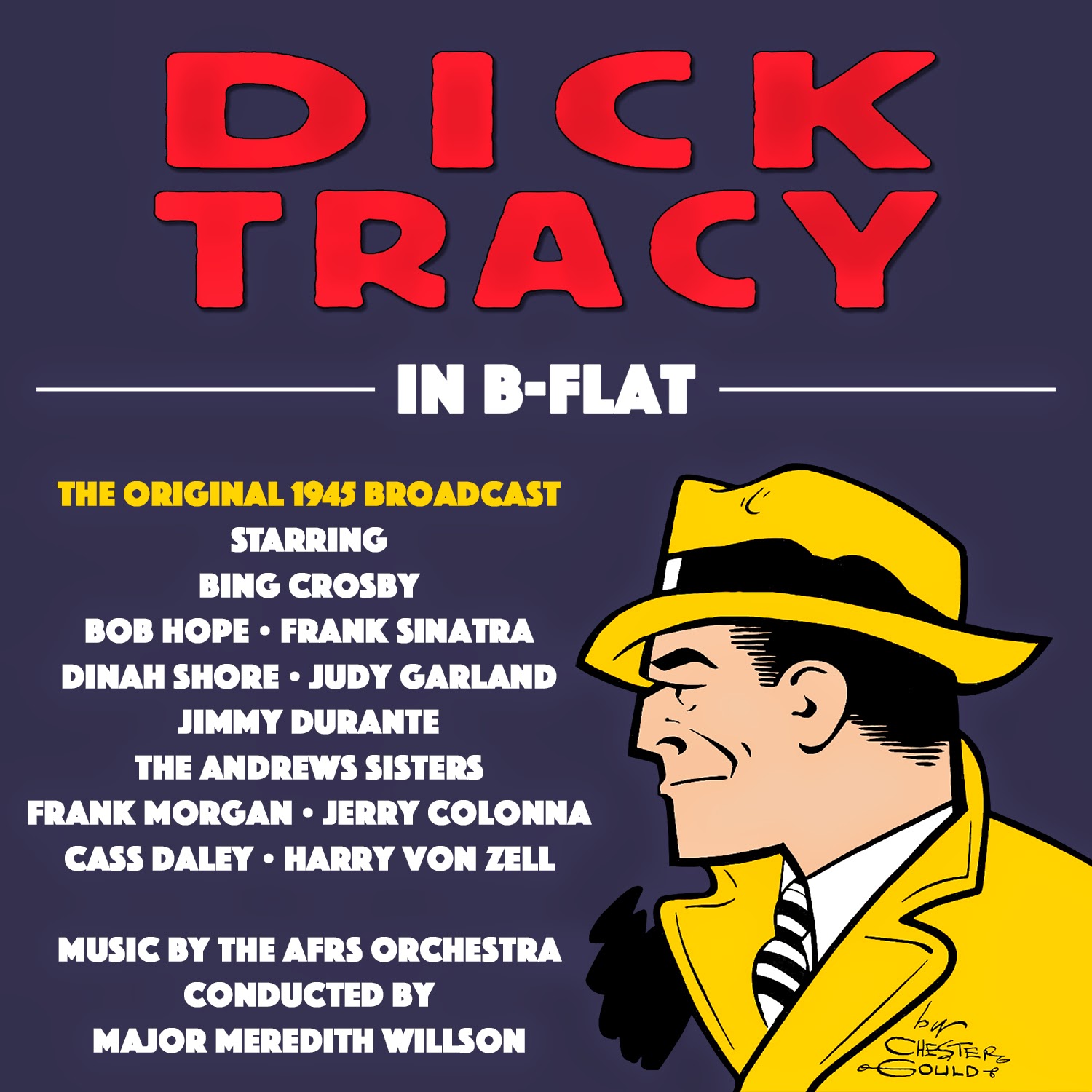
Album Art for the 1945 Command Performance of Dick Tracy in B-Flat
Design by Dan Cunningham
Dick Tracy © TMS News & Features, LLC

It wasn't long before weekly radio broadcasts with actors portraying the comic strip characters would begin to appear as regular series: Harold Gray's Little Orphan Annie became a major hit over the airwaves, just as it had on newspaper pages. During War Time, a particularly star-studded radio broadcast of a Dick Tracy musical was performed on the February 15, 1945 episode of Command Performance for The Armed Forces Radio Service. 

Bing Crosby, Dinah Shore, Frank Sinatra and Judy Garland Perform Dick Tracy in B-Flat for The Armed Forces Radio Service Broadcast

Dick Tracy in B-Flat (or For Goodness Sakes Isn’t He Ever Going to Marry Tess Trueheart?!) featured talent no less than Bing Crosby, Jimmy Durante, Judy Garland, Bob Hope, Dinah Shore, and Frank Sinatra, with an orchestra conducted by Meredith Wilson of The Music Man fame! Though played for laughs rather than action or drama, the musical is filled with original songs and parodies of many other popular tunes of the day.

Chic Young's Blondie Became an Ongoing Series of 28 Films For Columbia Pictures From 1938 to 1950
Image Courtesy of Kirby McDaniel Movie Art
© Columbia Pictures Industries, Inc.

On the silver screen, animated shorts continued to adapt strips such as Otto Soglow's The Little King and Rudolph Dirks's The Captain and the Kids. Chic Young's Blondie became a successful series of live-action films for Columbia Pictures, followed up by an intended series of live-action films based on Frank King's Gasoline Alley.

An Ever-Lovin' Blue-Eyed Record

Songs of the Pogo Was an Original Album Based on the Famous Comic Strip
Image Courtesy of Whirled of Kelly
Artwork by Walt Kelly, © Pogo Possum, Inc.

Moving beyond a single recording, another tactic was to compile an entire album based upon a comic strip—an early example of this is Songs of the Pogo from 1956. Walt Kelly chose several of the cleverly-worded doggerel poems sprinkled throughout paperback collections of his Pogo strips, and let composer Norman Monath construct tunes around them.

Walt Kelly Himself Performed a Few Selections for Songs of the Pogo
Image Courtesy of Flickr User VCU Libraries
Artwork by Walt Kelly, © Pogo Possum, Inc.

Those unfamiliar with the strip's Lewis Carroll flavored nonsense might grouse that most of the songs from the original LP have little to do with the Pogo characters, but the result is an excellent listening experience that is pure Walt Kelly. So pure, in fact, that Kelly himself, performs a few tracks on the album: his rendition of "Go-Go Pogo" is in the best style of a lively, tongue-twisting, vaudevillian opening act.

Comics Strips on the Small Screen
When television proved a success, a whole new landscape of opportunity opened up for comic strip adaptations. Limited or "planned" animation shorts featuring King Features strips such as Beetle Bailey and Snuffy Smith were created for modest budgets to insert into local kiddie TV programs. Meanwhile, entire blocks of new Popeye television shorts were created for both local and syndicated television packages.

The Addams Family Became a Success in Rerun Syndication For Decades
Image Courtesy of Mashable.com
© MGM Television/Sony Pictures Television

Hank Ketcham's Dennis the Menace became a memorable live-action family sitcom. A popular "slice of life" cartoon series in The New Yorker depicting a macabre clan also found its way to television: the single-panel gags created by Charles Addams turned into a monster success when The Addams Family premiered in 1964. The show's memorable music by Green Acres composer Vic Mizzy became an iconic TV theme song. The famous finger-snapping tune continues to be utilized each time The Addams Family is revived in various media.

Charles Schulz's Peanuts Became the First Animated Television Special Based on a Comic Strip
Image Courtesy of Red Carpet Report
Peanuts © Peanuts Worldwide, LLC

Television also became the perfect platform for an entirely new format of animating comic strip characters, beginning in 1965. A Charlie Brown Christmas premiered as a half-hour special on CBS, launching over fifty television specials, an animated series, and four feature films starring the Peanuts characters created by Charles M. Schulz. The television specials turned the already popular strip into a cultural phenomenon, the success of which continues to this day.

Vince Guaraldi Created the Unmistakable Jazz Stylings Identified With Animated Peanuts Projects
Image Courtesy of Jazz Profiles
Photo © Ray Avery/CTSImages

A tremendous part of the unique charm of the original Peanuts specials was the jazz underscore written and performed by San Francisco Bay Area musician Vince Guaraldi. After fifty years, his original composition "Linus and Lucy" stands out as the best-known music based on a comic strip, and has since become an American standard.

A Boom in the 1970s & 1980s
The unmistakable success of the Peanuts specials led to many other strips attempting to make the jump into television specials from the 1970s onward. These projects were received with varying degrees of success, but only a few landed ratings high enough for the network to order a series of special, such as Bil Keane's The Family Circus.

1977's A Doonesbury Special Featured Several Original Songs
Image Courtesy of VHS Collector
Doonesbury © G.B. Trudeau

One notable special was an adaptation of Garry Trudeau's topical strip Doonesbury, produced by animation veterans John and Faith Hubley for 1977's A Doonesbury Special. The special boasted full, personality-driven animation techniques (a rarity by the 1970s) and original pop songs that reflected the mindset of the upcoming generation. The songs were "performed" by the strip's resident pop star Jimmy Thudpucker, which were later collected on an LP featuring additional music by the fictional star.

Zonker Briefs Jimmy Thudpucker on Ginny Slade's Social Stances in Preparation for "Ginny's Song"
Image Courtesy of Streetlaughter
Doonesbury © G.B. Trudeau

The album also included a song that appeared as a 45" single two years earlier: "Ginny's Song" was a Thudpucker campaign song that tied directly into a strip storyline, in which law student Ginny Slade made a bold run for Congress.

The Garfield Television Specials Featured Original Songs With Vocals by Lou Rawls and Desiree Goyette
Image Courtesy of Pinterest User Jewel Harmon
Garfield © Paws, Inc.

The next big comic strip-to-television success arrived in the form of a lazy, fat, dry-witted house cat created by Jim Davis. In fact, Davis's Garfield became the first strong competitor to Schulz's Peanuts, as 1982 brought the CBS special Here Comes Garfield.

Album Art for the Here Comes Garfield Soundtrack LP
Garfield © Paws, Inc.

Perfectly voiced by Lorenzo Music, the sleepy-eyed cat struck a significant chord with the "Me" generation, leading to a series of annual TV specials and a top-rated Saturday morning animated series. A significant stamp of the original Garfield specials were the original songs performed by Low Rawls and Desiree Goyette—like Guaraldi's jazz score, the cool R&B vocals of Rawls was a unique element which gave the animated Garfield shows an identity.

Comic Strips on Broadway

Li'l Abner Heralded the Start of Broadway Musicals Based on Comic Strips
Image Courtesy of New Line Theater
Li'l Abner © Capp Enterprises, Inc.

Al Capp's Li'l Abner had made it's way to the Great White Way in 1956, packed full of songs with lyrics by the legendary Johnny Mercer. The musical Li'l Abner had respectable run on Broadway, but quickly became the darling of community theaters and school plays for decades to come—it is continually mounted across the country thanks to the value of simple sets and a large cast. A film version was produced by Paramount Pictures in 1959.

The Original Broadway Production of Annie Ran From 1977 to 1983
Pictured: Sandy Faison as Grace, Reid Shelton as Daddy Warbucks, Andrea McArdle as Annie
Image Courtesy of The New York Public Library
Photograph by Martha Swope
© The New York Public Library

Trudeau's Doonesbury experienced a brief run on Broadway, as did the Peanuts gang in several revivals of You're a Good Man, Charlie Brown. But the heaviest hitter was 1977's Annie, the Broadway musical version of Little Orphan Annie, which brought the world the well-known anthem "Tomorrow." The original Broadway production won a whopping seven Tony awards, and ran for nearly six years. Like Li'l Abner, Annie was adapted into a feature film by Columbia Pictures in 1982.

I'm a Boinger

Bloom County's Resident Heavy Metal Band "Deathtöngue" Became "Billy and the Boingers" Under the Pressure of a Senate Hearing Within the Strip
Image Courtesy of DeviantArt User MikeWeasel
Bloom County © Berkeley Breathed

Berkeley Breathed’s Bloom County also caught on quickly in the early 1980s, due in large part to Opus, the naive but outspoken penguin. Breathed’s humorous response to Garfield was Bill the Cat: a repulsive and near-comatose feline whose sole purpose was to generate sales of T-shirts, coffee mugs and plush dolls. Bill and Opus soon become the heart of the strip: for example, the pair ran for U.S. presidency on “The Meadow Ticket” on several occasions.

Album Art for Billy and the Boingers: Bootleg
Artwork by Berkeley Breathed
Bloom County © Berkeley Breathed

One of the most famous storylines centered around loudmouth lawyer Steve Dallas forming a heavy metal band headlined by Bill the Cat—their head-banging band Deathtöngue, was re-christened Billy and the Boingers during a series of daily strips featuring an accusatory Senate hearing on the negative effects of rock music. A 1987 Sunday comic invited actual bands to submit Boingers songs to be released on a flexi-disc record in the Bloom County collection, Billy and the Boingers: Bootleg.

Closing the 20th Century

Baby Blues Became an Animated Sitcom on the WB Network
Image Courtesy of Wikipedia
Baby Blues © Baby Blues Partnership

The mega-budget live-action Dick Tracy feature (which we discussed HERE) failed to spark the interest of film-goers. While the 1990s saw some new comic strips debut in newspapers, only a few made the transition to animation: in particular, Dilbert by Scott Adams, and Baby Blues by Rick Kirkman and Jerry Scott premiered as prime time animated television series. The latter featured the hit song "Its All Been Done" by Barenaked Ladies as the opening theme. Culling comic book properties or developing new, wholly-owned properties such as Spongebob Squarepants became the industry standard for most animation studios.

Aaron McGruder's The Boondocks Became a Popular Animated Series on Cartoon Network's [adult swim] Progamming Block in 2005
Image Courtesy of LeSean Thomas
The Boondocks © Aaron McGruder

One exception to this was Aaron McGruder's groundbreaking strip The Boondocks, which was developed as a series for Cartoon Network's [adult swim] block of evening programming. In line with the strip, the animated series took a slicing satirical view through the eyes of McGruder's adolescent protagonist Huey Freeman, who retains a harsh view of modern society in contrast to the extreme beliefs of the characters who surround him. The Boondocks animated series ran for four seasons, garnering critical acclaim for its sharp writing and hilarious, but brutal honesty.

A Vanishing Breed
With the ever-shrinking page count and newspaper circulation of the 21st Century, comic strips have taken a back seat to their successors of comic books. But there may be promise for new comic strips to thrive thanks to online publishing. Not to mention, each year an increasing number of publishers release hardcover editions of comprehensive, archived editions of classic newspaper strips. Though the delivery methods may change, the art of comic strip storytelling has a future for generations to come.

With some background fleshed out, let's have some music...

Album Art for Songs of Comic Strips Playlist Suggestions

There's a nice variety in this list of suggestions, which I've put together in order of the original appearance of each strip, rather than the projects that featured them. They flow nicely, with the capper of the full 48-minute broadcast of Dick Tracy in B-Flat, courtesy of our friends at archive.org.

Each song listed below is available on Amazon.com and iTunes. As usual, direct links to albums for both stores are provided below the description of each song, where you can listen to audio samples and purchase those that you might like to create your own Comic Strip inspired playlist. Please note: I don't get a piece of the profits if you make a purchase—the links are there to make things easy. While sampling, you might discover some new favorites!

Barney Google 
Artist: The Mellomen (Featuring Thurl Ravenscroft)
Album: Barbershop Melodies Vol. 3
Amazon  |  iTunes

You're Never Fully Dressed Without a Smile
Artist: Donald Craig, Laurie Beechman, Edie Cowan and Penny Worth
Album: Annie (Original 1977 Broadway Cast Recording)
Amazon  |  iTunes

I'm Popeye the Sailor Man
Artist: Billy Costello
Album: I'm Popeye the Sailor Man
Amazon  |  iTunes

Sooner or Later (From 1990's Feature Film Dick Tracy)
Artist: Bernadette Peters
Album: Bernadette Peters: Sondheim, Etc (Live at Carnegie Hall)
Amazon  |  iTunes

Alley Oop
Artist: The Hollywood Argyles
Album: Alley Oop / Hully Gully
Amazon  |  iTunes

Jubilation T. Cornpone
Artist: Stubby Kaye and Cast
Album: Li'l Abner Original Motion Picture Soundtrack
Amazon  |  iTunes

The Addams Family
Artist: Victor Mizzy and His Orchestra
Album: Original Music From The Addams Family
Amazon  |  iTunes
 
Go-Go Pogo
Artist: Waly Kelly (with Norman Monath)
Album: Songs of the Pogo
Amazon  |  iTunes

Linus and Lucy
Artist: The Vince Guraraldi Trio
Album: The Definitive Vince Guaraldi
Amazon  |  iTunes

Ginny's Song
Artist: Jimmy Thudpucker and the Walden West Rhythm Section
Album: Doonesbury's Jimmy Thudpucker Greatest Hits
CLICK HERE TO DOWNLOAD FREE MP3

Here Comes Garfield
Artist: Lou Rawls
Album: Here Comes Garfield (45 rpm Single)

CLICK HERE TO DOWNLOAD FREE MP3

I'm a Boinger
Artist: Billy and the Boingers
Album: Billy and the Boingers: Bootleg
CLICK HERE TO DOWNLOAD FREE MP3

It's All Been Done
Artist: Barenaked Ladies
Album: Stunt
Amazon  |  iTunes

The Boondocks (Main Title)
Artist: Asheru
Album: The Boondocks (Music From the Animated Series)
Amazon  |  iTunes

Dick Tracy in B-Flat
Artist: Armed Forces Radio Service
Command Performance (February 15, 1945 Broadcast)
CLICK HERE TO DOWNLOAD FREE MP3

ADDITIONAL MUSIC:

Doonesbury's Jimmy Thudpucker Greatest Hits
Complete Album with Artwork and Liner Notes
Courtesy of Taylor Jessen's Fuji Puzzle Box

Billy and the Boingers flexi-disc "B" side
"U Stink But I Love U"
Courtesy of firmland.com


NOTES AND ACKNOWLEDGMENTS

Tuesday, November 5, 2013

The Disney Comics Story (1990-1993): Prologue

Disney's Self-Published Comic Books Ran From 1990 to 1993
© Disney

The U.S. comic book boom of the 1980s restored the medium to the mainstream forefront. Once-sagging sales figures due to low circulation and constrictive distribution methods (discussed HERE) were back on the rise. This new attention brought forth publishing of new and resurrected titles during that period—a wide variety, the likes of which had been unavailable for decades.

Within that crop of fresh, four-color entertainment came a re-vamped line of Walt Disney comic book titles. The tale of The Walt Disney Company's stint at self-published comics is about to unfold here as a multi-part series... 

Don't Worry—We'll Get to This Guy Soon
Image Courtesy of Fantagraphics Books
© Disney

...but before we get to ducks and mice, let's have a bit of history to place things in context. In modern-day comics parlance, this post can be considered "Chapter Zero."

Coming of Age 
Comic books had taken a remarkable turn in the public eye by the close of the 20th Century. Legendary cartoonist Will Eisner's desire to elevate the art form was brought to fruition with the 1978 release of his seminal work A Contract With God. The dramatic collection of stories told through sequential art brought the term graphic novel into our lexicon.

Will Eisner's A Contract With God Was the First Widely Recognized Graphic Novel in the United States
Image Courtesy of willeisner.com
© Will Eisner

Exposure of graphic novels as literature was aided largely in part by the success of Art Spigelman's Holocaust memoir Maus, and Frank Miller's contemporary handling of an aging Bruce Wayne in The Dark Knight Returns. Selected graphic novels began to show up as The New York Times Best Sellers, and were added to public school reading lists (joining European imports such as Goscinny & Uderzo's Asterix series, and Herge's Tintin.)


Maus Recounted the Horrors of the Holocaust in Comic Strip Format, Casting Animals as Various Races and Nationalities
Interior Art Image Courtesy of  SHS Art Web Gallery
© Art Spiegleman

Something Old, Something New
In mainstream pop culture, a brand-new property captured the imagination of children and teenagers across the United States: Teenage Mutant Ninja Turtles began life as a self-published, independent black and white comic book by Kevin Eastman and Peter Laird. The crazy concept with the even crazier title caught on quickly when the characters were licensed as a highly sought-after line of toys and an immensely popular animated television series beginning in 1987. A quarter-consuming arcade game followed in 1989, with the first of three big-budget feature films slated for release in 1990. The favorable response to these oddball heroes let loose a flood of valuable merchandise and product tie-ins, all of which led back to comic books in the form of collected back issues, spin-offs, and an alternate comic book adaption of the animated series.


Eastman and Laird's Teenage Mutant Ninja Turtles Directly and Indirectly Helped Birth a New Generation of Comic Book Readers
Image Courtesy of Man-E-Toys
© Viacom International, Inc.

Close to follow was the much-hyped 1989 blockbuster cinematic release of Tim Burton's Batman for Warner Brothers, which placed the gritty world of Gotham City at the forefront of the DC Comics universe. The feature film boasted the inspired and unexpected casting of Michael Keaton in the titular role, and Jack Nicholson as the Joker, accompanied by a chart-topping, multi-platinum soundtrack featuring original music by Prince. This cross-demographic appeal couldn't be ignored, and it was impossible to turn a corner during the summer of '89 without seeing the familiar winged logo. Naturally, this led to a profitable wave of bat-branded merchandise, from T-shirts to breakfast cereal to video games, and cyclically, back again to comic books. New and collected Batman and Joker stories from DC Comics were in high demand, in addition to the official Batman movie comics adaption written by Denny O'Neil with lush art by Jerry Ordway.

The Summer of 1989 Was the Summer of Batman: The Hit Feature Film Brought Another New Audience and Former Readers Back to Comic Books
Image Courtesy of Wide Screen World
© DC Comics/Warner Bros.

The Turtle and Bat phenomena were remarkably timed: both properties ignited dual fuses, causing an explosion in the American comic book marketplace. A new generation discovered comic book entertainment via other forms of entertainment media, finding their way to newsstands and the relatively new establishments known as comic book shops that had surfaced in the past decade.

Comic Book Shops Opened Around the Country During the 1980s
Image © and Courtesy of Comics101.com

This surge in popularity benefited lifelong, core fans of classic comic book heroes like Superman, Batman, Spider-Man and the X-Mentheir commitment rewarded with hardbound collections, expanded content and spin-off titles of favorite characters. But a boost from pop culture movies and television was only half of the reason for the explosion...
  
The Collector's Market 
While some sought entertainment, an equal share of others came looking to cash in on the "easy money" of soaring prices for vintage and current back issues that the news outlets had begun to exploit. The comic book collector's market was in full swing.

The Comic Book Collector's Boom Helped the Overstreet Comic Book Price Guide Expand and Spawned Many Periodicals on Comic Collecting

The speculation boom lured adult consumers who would never otherwise pick up a comic book, and publishers made sure to keep them coming back each week. Some crafty marketing techniques to ensure a single customer's multiple purchases of the same issue included limited print runs, polybagged editions, variants (different cover art on the same issue) and embellished "incentive" covers.

Cover Gag for Bartman #1:
 The Simpsons Have Satirized Everything, Including the Comics Industry's Sales-Drving Technique of Cover Variants and Enhancements
Image Courtesy of Simpson Crazy
© Twentieth Century Fox Film Corporation

New comic book shops quickly opened up across the country to service the new audience that arrived on the comics scene, fueled by the factors above. One thing was clear—comic books were no longer just for kids. They were now taken seriously as:
  • a form of literature,
  • an extension of popular movie and television productions,
  • valuable to the corporations that owned the I.P., and
  • investments to speculators who spent serious money each week on new releases
The funny books had indeed come of age. A long way from the days of languishing sales in the 1970s, and even further from the slings and arrows of Dr. Fredric Wertham's Seduction of the Innocent in 1954.

Mouse House Resurrected


The Animation Department Poses For One Final Picture Before Their Evacuation From the Walt Disney Studio's Main Lot (Circa 1984)
Courtesy of The Pixar Podcast
© Disney

Like the comic book industry, Walt Disney Productions was emerging from dark times as well by the of the decade. Upon surviving a hostile takeover and near-liquidation by Investors and corporate raiders, the wilting media powerhouse became re-established as The Walt Disney Company in 1985 with the appointment of Michael Eisner as CEO/Chairman of the Board and Frank Wells as Presidenttheir early restructuring of the company and updating of the Studio's output and image took a near-immediate hold.

Existing projects in varying stages of development were heavily scrutinized, and the notion of productions more in line with competing Studios no longer eschewed. This included animated product as well. Prior to the 1989 release of The Little Mermaid and the money-making template it would cast, two high-grossing achievements of the decade were animated projects that fueled new excitement by reaching into the Studio's past:


 The Syndicated TV Series DuckTales Owed Its Success to the Walt Disney Comic Book Stories of Carl Barks
Image Courtesy of Financial Post
© Disney

The first was the 1987 original animated series DuckTales, with a heavy foundation on the comic book stories of Carl Barks. The syndicated afternoon show debuted with consistently high ratings, thanks to a healthy budget offering scripts and visuals of much higher quality compared to most animated television offerings of the time. A combination of classic and new characters led to a remarkable 100-episode run, spawning a hit video game, and a full-length feature film released to theaters in 1990.

A Bounty of New DuckTales Comics Were Produced In Argentina and Italy, Featuring Characters From the Popular Television Series
Panel Detail From Gladstone Publishing's DuckTales #13 (Series I—March 1990) 
Art by The Jamie Diaz Studios  
© Disney

New comic book stories featuring DuckTales characters were produced by Italian Publishers and through the Jamie Diaz Studios in Argentina, appearing in U.S. and overseas comic books, digests and magazines.

A Critical Success and a Technical Marvel, Who Framed Roger Rabbit? Restored the Value of Classic Cartoon Characters From Multiple Studios
Image Courtesy of Blu-Ray.com
© Disney/Amblin

The second project followed ten months later, with the 1988 release of Who Framed Roger Rabbit? a joint project with Disney's new Touchstone Pictures division and Steven Spielberg's Amblin Entertainment. The box office smash created a significant boost in interest of well-known classic animated properties seen in the film from various Hollywood Studios. The new characters of Roger Rabbit, Jessica Rabbit and Baby Herman became instant classics, and Disney immediately set up production of a new series of short cartoons with significant plans to incorporate them into the theme parks.

 Marvel Comics Published the Graphic Novel Adaption of Who Framed Roger Rabbit? Combining the Talents of Comic Book Legends Dan Spiegle and Daan Jippes
© Disney/Amblin

In a bit of ironic foreshadowing, a comic book adaption of the film was released as a prestige format graphic novel by Marvel Comics in 1989, some twenty years prior to The Walt Disney Company's $4+ Billion acquisition of Marvel Entertainment. The oversize adaption shined with art by a pair of comics legend: Dan Spiegle handled the live-action scenes incorporated with cartoon characters and settings by Daan Jippes.

These projects broke the ice of a notably stale two decades of lackluster animated fare. In another direct parallel to comic book publishers, the recent success prompted Disney's re-examination of their existing I.P. and aggressive development of new properties.


This re-examination included the Walt Disney comic book license and the deal that was currently in place, about 400 miles southeast of Burbank, CA...

There's Always Another Rainbow

Another Rainbow Publishing Held the Walt Disney Comic Book License Through Their Gladstone Imprint From 1985 to 1990
Image Courtesy of The Comic Prospector
© Disney

In 1986, the license to publish Walt Disney comic books had been granted to Another Rainbow Publishing, a modest company in Scottsdale (later, Prescott,) Arizona. Founded and run by two well-known collectors and champions of comics as an art form: Russ Cochran and Bruce Hamilton. Another Rainbow had already met success with lavish lithographs and a special edition book of Carl Barks's oil paintings. These were produced alongside a high-end, archival series of hardcover box sets reprinting the entirety of Barks's Walt Disney comic book work, as well as E.C.'s line of Horror comics and Marjorie Henderson Buell's Little Lulu.

 Another Rainbow Produced The Original Carl Barks Library:
Ten, Three-Book Box Sets (Set I Pictured Above)
Product Image Courtesy of My Comic Shop
© Disney

Cochran and Hamilton may have lacked the financial clout of Eisner and Wells, but where they lacked in dollars, they made up for in heart. So devoted to the work of Carl Barks were the duo, that their company name was based on the title of an early Barks oil painting of a young Scrooge McDuck: Always Another Rainbow. The imprint for their Walt Disney comic book license would bear a similar tribute: Gladstone Comics was named after the Barks-created cousin of Donald Duck with perpetual good luck: Gladstone Gander.

Cochran and Hamilton Named Their Comic Book Line After Donald Duck's Frustratingly Lucky Cousin, Gladstone Gander
Image Courtesy of Duck Comics Revue
© Disney

Two 100-page specials appeared on newsstands in late 1985, followed by the debut of the  "core four" monthly titles* in July of 1986. As Gladstone's launch restored Walt Disney comic books to newsstands and spinner racks, they received a bump in sales and critical praise. Bi-monthly titles, prestige format albums and specials were gradually added to their publushing schedule.

 Utilizing Excellent Presentation and Carefully Selected Content, Gladstone Published Some of the Finest Stateside Walt Disney Comic Book Titles
Image Courtesy of Filmic Light
© Disney

Editors took great care in presenting each issue's content: for the first time in the United States, Disney stories and art were properly credited to the artists, writers and colorists in the format they were originally presented. Thought-provoking text articles often accompanied comic stories, providing context and history on the featured tales. Not only did the Gladstone books reprint and credit classic domestic stories, they imported a HUGE treasure trove of translated stories from Disney's mammoth Danish comics publisher, The Gutenberghus Group (now The Egmont Group.) The original Gladstone comics also gave modern-day comic legends Don Rosa and William Van Horn their first chance at creating official duck stories.

Gladstone's Uncle Scrooge #219 Debuted The Son of the Son: Don Rosa's First Official Disney Duck Story
Image Courtesy of The D.U.C.K.Man
© Disney

Initially, the Another Rainbow/Gladstone staff had minimal interference from Burbank executives, who were likely pleased with long-dormant profit from U.S. comic books. In turn, the comics likely experienced a bump from the September 1987 debut of DuckTales as a new generation discovered the exploits of the world's richest duck each weekday afternoon. But the powerful wake of new success impacting The Walt Disney Company was about to shake up the fate of the Gladstone comic book license significantly.

Comic Influences
The news media's increasing focus on comics books and related properties such as Batman and Teenage Mutant Ninja Turtles had motivated the Disney Studio to greenlight production of TWO big budget, live-action film adaptions of comic properties:

Dick Tracy (1990)
Poster Art Courtesy of Flick Facts
© Disney/TMS News and Features, LLC

Slated for release in the summer of 1990 was a highly-touted film adaption of Chester Gould's famous comic strip detective Dick Tracy, starring Warren Beatty, Al Pacino, Madonna and a slew of memorable cameos.

The Rocketeer (1991)
Poster Art Courtesy of Collider
© Disney

The following summer was a property the Studio optioned several years earlier: The Rocketeer, a popular independent comic book by Dave Stevens, with a Saturday Matinee serial flavor, starring Billy Campbell, Jennifer Connolly and Alan Arkin.

Of course, Dick Tracy and The Rocketeer were licensed outside properties with adventure and action themes (the type of which The Walt Disney Company didn't own outright). This returns us to the Company's aforementioned re-examination of their existing I.P.which included looking closer at their own comic book output through Gladstone Publishing.

Fallout
Creative notes from a once-quiet Burbank began to show up at the Gladstone offices more frequently: one notorious incident was a note regarding Barks-drawn duck characters looking "off-model" on the cover of a comic book album, suggesting Studio-approved models in it's place.

The Carl Barks-Drawn Cover to Gladstone Comic Album #21: Donald Duck Family Sparked a Surprising Red Flag From Burbank Executives
Image Courtesy of Amazon.com
© Disney

Gladstone's four-year output of Carl Barks covers were never a conflict before—it became apparent that while the marketing folks enjoyed profits from the work of Barks and many other Disney comic artists, they held little notion of their content or value. The I.P. was considered more valuable than the reason the comics were popular in the first place.

The truth was: if it wasn't for Carl Barks's ducks and Floyd Gottfredson's mice, there would likely be no market for reprints of Walt Disney comics in the first place.


1980s Marketing Executives Never Quite Pieced Together That the Work of Carl Barks (Right) and Floyd Gottfredson (Left) Set the Standard For Walt Disney Comic Books Around the Globe
Portrait Photo Courtesy of  Carl Barks Art
© Disney

Similar interference continued until the close of 1989, when The Walt Disney Company chose not to renew their comic book license with Another Rainbow/Gladstone. The resurgence in interest of their classic characters and the boom in the comic book market inspired Disney to undertake something they'd always left to others: the company would publish the comic books themselves. The desire being that all profits could be kept in-house, and editorial control wouldn't receive any creative pushback. This business plan now in motion, the final Gladstone comics were released to newsstands and comic book publishers during the first three months of 1990.

A class act up to the end, Gladstone didn't cover up or hide what was to come, nor were they outwardly vengeful or bitterclick the image below to read their farewell message to faithful readers, and a hint of the change that would come to Walt Disney comic books the following month:

Editor Geoffrey Blum Wishes The New Disney Comics Effort Well in the Final "Cross Talk" Section of the Original Gladstone Run
© Disney


End Prologue
So... this finally brings us to the doorstep of our main topic—there's plenty more to come, but this is a pretty logical stopping point. 

Below are a few images to serve as a preview of what to expect in the next chapter, in which everything discussed here converges into into the preparation and launch of the 1990 Disney Comics line (and that's exactly what the comic book imprint was named):

"This Could Be The Start of Something BIG!"
The First Official Advertisement For Disney's Self-Published Disney Comics Line
© Disney/Amblin

Synergy was keyan in-house Disney Comics line would be the perfect place where a tie-in to an upcoming comic-based big-budget film could be exploited:

In 1990, a Mini-Series and Official Comics Adaption of the Disney Studio's Upcoming Dick Tracy Feature Was a Natural Fit
© Disney/TMS News and Features, LLC

To create buzz and entice the collector's market, most titles were reset to issue #1 to promote collectability, while classic and new characters were given titles of their very own:

At the Initial Launch of the 1990 Disney Comics Line, New and Classic Disney Characters Received Their Own Titles
© Disney/Amblin

The start of the Disney Comics line was a bold endeavor, with an even bolder publishing plan. Click the title below to continue to the next installment:


* The long-running "core four" titles in U.S. Walt Disney comic books are Donald Duck, Mickey Mouse, Uncle Scrooge and Walt Disney's Comics and Stories: these four titles have been restored most often by comic book publishers that acquire the license.