Showing posts with label Playlists. Show all posts

Monday, February 9, 2015

Playlist: Songs of Comic Strips

Newspaper Comic Strips Were Adapted Into Other Entertainment Media Such as Radio, Movies, Television and Records
Image Courtesy of Blaine's Puzzle Blog

This round of playlist suggestions has a set of rules: the songs are inspired by properties that began as comic strips. So any characters that originated in animation or comic books that were subsequently featured in comic strips (such as Felix the Cat, Mickey Mouse, Superman or Archie) are excluded! Sometime down the line, we'll shine a light on music inspired by comic book characters, and other variations… for today, let's get some printer's ink on our fingers.

There's Plenty of Links at the End of the Post to Start Up Your Own Comic Strip Playlist
Image Courtesy of Karl Tryggvason
Artwork by Charles M. Schulz
Peanuts © Peanuts Worldwide, LLC

I'm also happy to tell you that beyond the usual links to Amazon and iTunes albums, this playlist offers FOUR free MP3 downloads, with links to several more free tracks to get your own comic strip playlist going.

Sunday Funnies
During the 20th century, a significant highlight of the American weekend occurred each Sunday morning. Often procured by a trip to the corner drugstore as a thick bundle held snugly under the arm, or as a thunderous THUMP on the front porch. Either delivery method meant that much-anticipated token, the Sunday edition of the local newspaper, had arrived.

An Example of a 1939 Sunday Comics Page
Scan Courtesy of Animation Resources

Of all the expanded features within, the section ranking highest desirability was the large, full-color comic section. The Sunday comics were most often exposed as the front-facing layer cradling the bulky strata of the entire Sunday edition, like tempting and colorful Christmas wrapping paper. The Sunday comics were lovingly referred to early on as "The Funny Papers" or simply "The Funnies."

Government Worker Reads the Sunday Comics on the Back Porch at Arlington Farms, VA Residence for Women (1943)
Image Courtesy of History in Photos

It was here that the latest chapter of favorite serialized adventures such as Chester Gould's Dick Tracy and Milton Caniff's Terry and the Pirates were found, leaving another cliffhanger for next week's not-to-be-missed installment. Laughs could be had from Frank King's Gasoline Alley and Al Capp's Li'l Abner, while Walt Kelly's Pogo brought hilarious social and political through the eyes of the "critters" of Okefenokee Swamp.

Whether in crisp black and white daily strips or in full color on Sundays, it's easy to see why "The Funnies" became the most coveted section for every member of the household. This was an especially important (and affordable) diversion during the era of the Great Depression.

Appointment Reading
How popular were the continuing adventures of newspaper comics? A 1945 New York City newspaper delivery strike left readers and subscribers frustrated that their households were missing out on the latest installments of their favorite comic strips. So much so, that New York’s Mayor Fiorello LaGuardia solved the problem by reading the Sunday comics over the air during his weekly radio address. Thanks to the archives of WNYC public radio, here's a sample clip of the Mayor's July 8, 1945 broadcast:


Early Comic Strip Songs
From the early part of the 20th century, several comic strips had already stood out in popularity, and became vehicles for other media. Since radio was the most popular form of entertainment within the home, it was a natural conclusion to adapt comic strip characters into music and audio dramatizations.

"Barney Google (Foxtrot)" by Billy Rose Became the First Popular Song Based on a Comic Strip Property
Image Courtesy of museumofplay.org
© King Features Syndicate, Inc.

The first hit song that was birthed from a comic strip was released in 1923: a novelty song titled ”Barney Google (Foxtrot)" (better known as "Barney Google with the Goo-Goo-Googly Eyes") written and performed by Billy Rose. The song was penned in honor of Billy DeBeck's Barney Google and Spark Plug at the peak of the strip's popularity, and performed by several recording stars of the 1920s and 1930s. Though such buzz words didn't exist at the time, these were the beginning days of synergistic multimedia properties.

Time-Traveling Caveman Alley Oop Became the Subject of a No. 1 Pop Single in 1960
Image Courtesy of I Love Comix Archive
Artwork by V.T. Hamlin
Alley Oop © United Features Syndicate

Years later, the trend continued on the pop charts: V.T. Hamlin's comic strip caveman Alley Oop was immortalized by The Hollywood Argyles in 1960 with a number one hit of the same name. The Royal Guardsmen capitalized on the success of the Peanuts craze, with "Snoopy vs. the Red Baron" in 1966 and several follow-ups afterward—but their songs would only be marginally identified with the Peanuts strip.

Comic Strips Become Animated Shorts

Winsor McCay Personally Produced Two Silent Animated Shorts Based on His Comic Strip Masterpiece Little Nemo in Slumberland
Image Courtesy of Dr. Grob's Animation Review
Artwork by Winsor McKay

Theatrical animation became the next logical outlet, around the time Walt Disney began his ascent to fame due to the smashing popularity of Mickey Mouse. Winsor McCay had already created silent animated shorts of his Little Nemo in Slumberland strip, while Max Fleischer made an important addition to his own Studio: Fleischer had obtained the rights to produce a series of animated theatrical shorts starring the breakout character Popeye the Sailor from Elzie Segar's Thimble Theater.

The Well-Known Tune "I'm Popeye the Sailor Man" Made Its Debut With Popeye's First Theatrical Cartoon in 1933
Image Courtesy of Heritage Auctions
© King Features Syndicate, Inc.

Popeye's memorable theme song "I'm Popeye the Sailor Man" was penned by Fleischer Studio composer Sammy Lerner, and became as popular as the one-eyed sailor himself. Early merchandising efforts beyond audio and animation were also beginning to surface: George Herriman's Krazy Kat, Sidney Smith's The Gumps and other popular strips began to surface on products such as toys, rag dolls, writing tablets, and children’s savings banks.

Comic Strips Come to Life
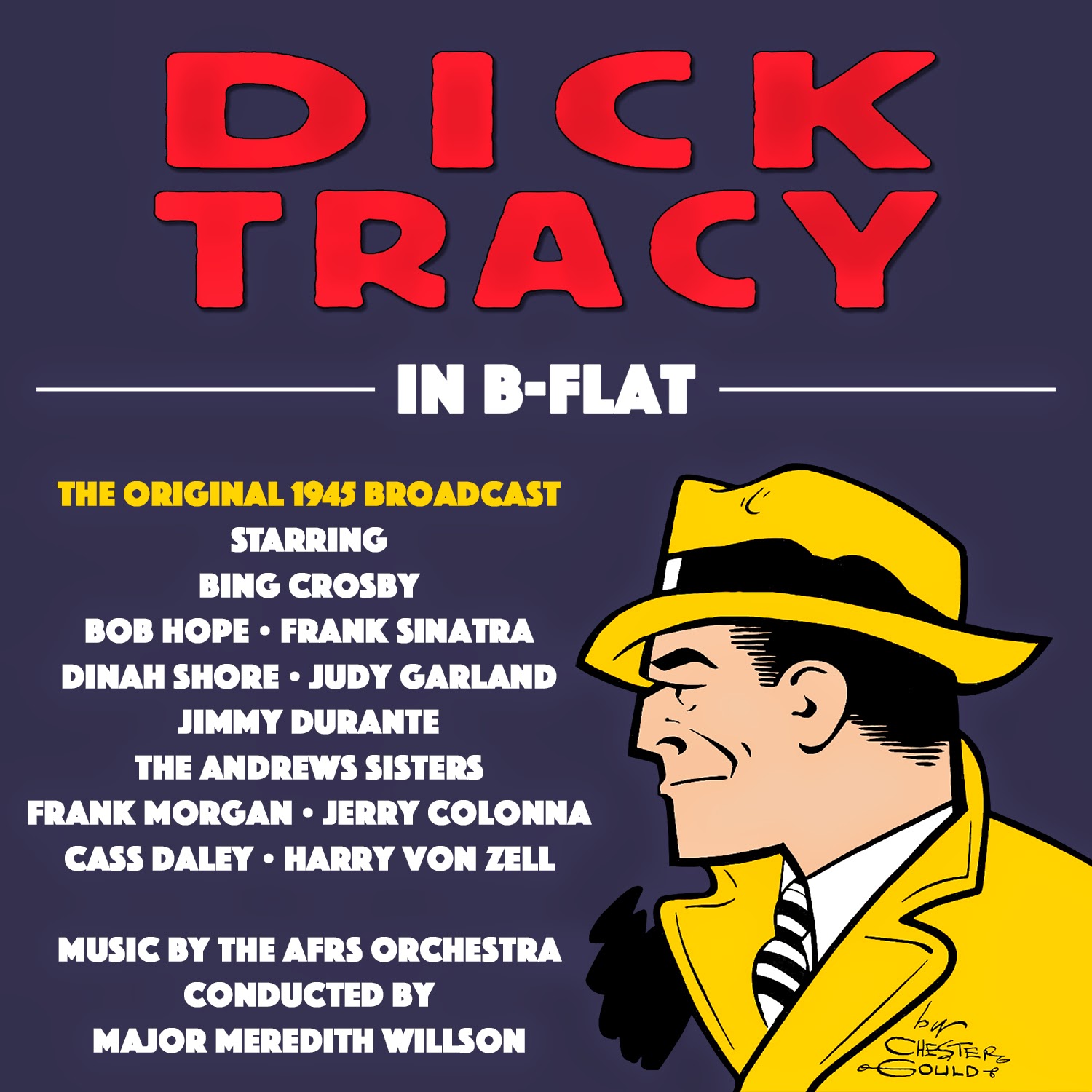
Album Art for the 1945 Command Performance of Dick Tracy in B-Flat
Design by Dan Cunningham
Dick Tracy © TMS News & Features, LLC

It wasn't long before weekly radio broadcasts with actors portraying the comic strip characters would begin to appear as regular series: Harold Gray's Little Orphan Annie became a major hit over the airwaves, just as it had on newspaper pages. During War Time, a particularly star-studded radio broadcast of a Dick Tracy musical was performed on the February 15, 1945 episode of Command Performance for The Armed Forces Radio Service. 

Bing Crosby, Dinah Shore, Frank Sinatra and Judy Garland Perform Dick Tracy in B-Flat for The Armed Forces Radio Service Broadcast

Dick Tracy in B-Flat (or For Goodness Sakes Isn’t He Ever Going to Marry Tess Trueheart?!) featured talent no less than Bing Crosby, Jimmy Durante, Judy Garland, Bob Hope, Dinah Shore, and Frank Sinatra, with an orchestra conducted by Meredith Wilson of The Music Man fame! Though played for laughs rather than action or drama, the musical is filled with original songs and parodies of many other popular tunes of the day.

Chic Young's Blondie Became an Ongoing Series of 28 Films For Columbia Pictures From 1938 to 1950
Image Courtesy of Kirby McDaniel Movie Art
© Columbia Pictures Industries, Inc.

On the silver screen, animated shorts continued to adapt strips such as Otto Soglow's The Little King and Rudolph Dirks's The Captain and the Kids. Chic Young's Blondie became a successful series of live-action films for Columbia Pictures, followed up by an intended series of live-action films based on Frank King's Gasoline Alley.

An Ever-Lovin' Blue-Eyed Record

Songs of the Pogo Was an Original Album Based on the Famous Comic Strip
Image Courtesy of Whirled of Kelly
Artwork by Walt Kelly, © Pogo Possum, Inc.

Moving beyond a single recording, another tactic was to compile an entire album based upon a comic strip—an early example of this is Songs of the Pogo from 1956. Walt Kelly chose several of the cleverly-worded doggerel poems sprinkled throughout paperback collections of his Pogo strips, and let composer Norman Monath construct tunes around them.

Walt Kelly Himself Performed a Few Selections for Songs of the Pogo
Image Courtesy of Flickr User VCU Libraries
Artwork by Walt Kelly, © Pogo Possum, Inc.

Those unfamiliar with the strip's Lewis Carroll flavored nonsense might grouse that most of the songs from the original LP have little to do with the Pogo characters, but the result is an excellent listening experience that is pure Walt Kelly. So pure, in fact, that Kelly himself, performs a few tracks on the album: his rendition of "Go-Go Pogo" is in the best style of a lively, tongue-twisting, vaudevillian opening act.

Comics Strips on the Small Screen
When television proved a success, a whole new landscape of opportunity opened up for comic strip adaptations. Limited or "planned" animation shorts featuring King Features strips such as Beetle Bailey and Snuffy Smith were created for modest budgets to insert into local kiddie TV programs. Meanwhile, entire blocks of new Popeye television shorts were created for both local and syndicated television packages.

The Addams Family Became a Success in Rerun Syndication For Decades
Image Courtesy of Mashable.com
© MGM Television/Sony Pictures Television

Hank Ketcham's Dennis the Menace became a memorable live-action family sitcom. A popular "slice of life" cartoon series in The New Yorker depicting a macabre clan also found its way to television: the single-panel gags created by Charles Addams turned into a monster success when The Addams Family premiered in 1964. The show's memorable music by Green Acres composer Vic Mizzy became an iconic TV theme song. The famous finger-snapping tune continues to be utilized each time The Addams Family is revived in various media.

Charles Schulz's Peanuts Became the First Animated Television Special Based on a Comic Strip
Image Courtesy of Red Carpet Report
Peanuts © Peanuts Worldwide, LLC

Television also became the perfect platform for an entirely new format of animating comic strip characters, beginning in 1965. A Charlie Brown Christmas premiered as a half-hour special on CBS, launching over fifty television specials, an animated series, and four feature films starring the Peanuts characters created by Charles M. Schulz. The television specials turned the already popular strip into a cultural phenomenon, the success of which continues to this day.

Vince Guaraldi Created the Unmistakable Jazz Stylings Identified With Animated Peanuts Projects
Image Courtesy of Jazz Profiles
Photo © Ray Avery/CTSImages

A tremendous part of the unique charm of the original Peanuts specials was the jazz underscore written and performed by San Francisco Bay Area musician Vince Guaraldi. After fifty years, his original composition "Linus and Lucy" stands out as the best-known music based on a comic strip, and has since become an American standard.

A Boom in the 1970s & 1980s
The unmistakable success of the Peanuts specials led to many other strips attempting to make the jump into television specials from the 1970s onward. These projects were received with varying degrees of success, but only a few landed ratings high enough for the network to order a series of special, such as Bil Keane's The Family Circus.

1977's A Doonesbury Special Featured Several Original Songs
Image Courtesy of VHS Collector
Doonesbury © G.B. Trudeau

One notable special was an adaptation of Garry Trudeau's topical strip Doonesbury, produced by animation veterans John and Faith Hubley for 1977's A Doonesbury Special. The special boasted full, personality-driven animation techniques (a rarity by the 1970s) and original pop songs that reflected the mindset of the upcoming generation. The songs were "performed" by the strip's resident pop star Jimmy Thudpucker, which were later collected on an LP featuring additional music by the fictional star.

Zonker Briefs Jimmy Thudpucker on Ginny Slade's Social Stances in Preparation for "Ginny's Song"
Image Courtesy of Streetlaughter
Doonesbury © G.B. Trudeau

The album also included a song that appeared as a 45" single two years earlier: "Ginny's Song" was a Thudpucker campaign song that tied directly into a strip storyline, in which law student Ginny Slade made a bold run for Congress.

The Garfield Television Specials Featured Original Songs With Vocals by Lou Rawls and Desiree Goyette
Image Courtesy of Pinterest User Jewel Harmon
Garfield © Paws, Inc.

The next big comic strip-to-television success arrived in the form of a lazy, fat, dry-witted house cat created by Jim Davis. In fact, Davis's Garfield became the first strong competitor to Schulz's Peanuts, as 1982 brought the CBS special Here Comes Garfield.

Album Art for the Here Comes Garfield Soundtrack LP
Garfield © Paws, Inc.

Perfectly voiced by Lorenzo Music, the sleepy-eyed cat struck a significant chord with the "Me" generation, leading to a series of annual TV specials and a top-rated Saturday morning animated series. A significant stamp of the original Garfield specials were the original songs performed by Low Rawls and Desiree Goyette—like Guaraldi's jazz score, the cool R&B vocals of Rawls was a unique element which gave the animated Garfield shows an identity.

Comic Strips on Broadway

Li'l Abner Heralded the Start of Broadway Musicals Based on Comic Strips
Image Courtesy of New Line Theater
Li'l Abner © Capp Enterprises, Inc.

Al Capp's Li'l Abner had made it's way to the Great White Way in 1956, packed full of songs with lyrics by the legendary Johnny Mercer. The musical Li'l Abner had respectable run on Broadway, but quickly became the darling of community theaters and school plays for decades to come—it is continually mounted across the country thanks to the value of simple sets and a large cast. A film version was produced by Paramount Pictures in 1959.

The Original Broadway Production of Annie Ran From 1977 to 1983
Pictured: Sandy Faison as Grace, Reid Shelton as Daddy Warbucks, Andrea McArdle as Annie
Image Courtesy of The New York Public Library
Photograph by Martha Swope
© The New York Public Library

Trudeau's Doonesbury experienced a brief run on Broadway, as did the Peanuts gang in several revivals of You're a Good Man, Charlie Brown. But the heaviest hitter was 1977's Annie, the Broadway musical version of Little Orphan Annie, which brought the world the well-known anthem "Tomorrow." The original Broadway production won a whopping seven Tony awards, and ran for nearly six years. Like Li'l Abner, Annie was adapted into a feature film by Columbia Pictures in 1982.

I'm a Boinger

Bloom County's Resident Heavy Metal Band "Deathtöngue" Became "Billy and the Boingers" Under the Pressure of a Senate Hearing Within the Strip
Image Courtesy of DeviantArt User MikeWeasel
Bloom County © Berkeley Breathed

Berkeley Breathed’s Bloom County also caught on quickly in the early 1980s, due in large part to Opus, the naive but outspoken penguin. Breathed’s humorous response to Garfield was Bill the Cat: a repulsive and near-comatose feline whose sole purpose was to generate sales of T-shirts, coffee mugs and plush dolls. Bill and Opus soon become the heart of the strip: for example, the pair ran for U.S. presidency on “The Meadow Ticket” on several occasions.

Album Art for Billy and the Boingers: Bootleg
Artwork by Berkeley Breathed
Bloom County © Berkeley Breathed

One of the most famous storylines centered around loudmouth lawyer Steve Dallas forming a heavy metal band headlined by Bill the Cat—their head-banging band Deathtöngue, was re-christened Billy and the Boingers during a series of daily strips featuring an accusatory Senate hearing on the negative effects of rock music. A 1987 Sunday comic invited actual bands to submit Boingers songs to be released on a flexi-disc record in the Bloom County collection, Billy and the Boingers: Bootleg.

Closing the 20th Century

Baby Blues Became an Animated Sitcom on the WB Network
Image Courtesy of Wikipedia
Baby Blues © Baby Blues Partnership

The mega-budget live-action Dick Tracy feature (which we discussed HERE) failed to spark the interest of film-goers. While the 1990s saw some new comic strips debut in newspapers, only a few made the transition to animation: in particular, Dilbert by Scott Adams, and Baby Blues by Rick Kirkman and Jerry Scott premiered as prime time animated television series. The latter featured the hit song "Its All Been Done" by Barenaked Ladies as the opening theme. Culling comic book properties or developing new, wholly-owned properties such as Spongebob Squarepants became the industry standard for most animation studios.

Aaron McGruder's The Boondocks Became a Popular Animated Series on Cartoon Network's [adult swim] Progamming Block in 2005
Image Courtesy of LeSean Thomas
The Boondocks © Aaron McGruder

One exception to this was Aaron McGruder's groundbreaking strip The Boondocks, which was developed as a series for Cartoon Network's [adult swim] block of evening programming. In line with the strip, the animated series took a slicing satirical view through the eyes of McGruder's adolescent protagonist Huey Freeman, who retains a harsh view of modern society in contrast to the extreme beliefs of the characters who surround him. The Boondocks animated series ran for four seasons, garnering critical acclaim for its sharp writing and hilarious, but brutal honesty.

A Vanishing Breed
With the ever-shrinking page count and newspaper circulation of the 21st Century, comic strips have taken a back seat to their successors of comic books. But there may be promise for new comic strips to thrive thanks to online publishing. Not to mention, each year an increasing number of publishers release hardcover editions of comprehensive, archived editions of classic newspaper strips. Though the delivery methods may change, the art of comic strip storytelling has a future for generations to come.

With some background fleshed out, let's have some music...

Album Art for Songs of Comic Strips Playlist Suggestions

There's a nice variety in this list of suggestions, which I've put together in order of the original appearance of each strip, rather than the projects that featured them. They flow nicely, with the capper of the full 48-minute broadcast of Dick Tracy in B-Flat, courtesy of our friends at archive.org.

Each song listed below is available on Amazon.com and iTunes. As usual, direct links to albums for both stores are provided below the description of each song, where you can listen to audio samples and purchase those that you might like to create your own Comic Strip inspired playlist. Please note: I don't get a piece of the profits if you make a purchase—the links are there to make things easy. While sampling, you might discover some new favorites!

Barney Google 
Artist: The Mellomen (Featuring Thurl Ravenscroft)
Album: Barbershop Melodies Vol. 3
Amazon  |  iTunes

You're Never Fully Dressed Without a Smile
Artist: Donald Craig, Laurie Beechman, Edie Cowan and Penny Worth
Album: Annie (Original 1977 Broadway Cast Recording)
Amazon  |  iTunes

I'm Popeye the Sailor Man
Artist: Billy Costello
Album: I'm Popeye the Sailor Man
Amazon  |  iTunes

Sooner or Later (From 1990's Feature Film Dick Tracy)
Artist: Bernadette Peters
Album: Bernadette Peters: Sondheim, Etc (Live at Carnegie Hall)
Amazon  |  iTunes

Alley Oop
Artist: The Hollywood Argyles
Album: Alley Oop / Hully Gully
Amazon  |  iTunes

Jubilation T. Cornpone
Artist: Stubby Kaye and Cast
Album: Li'l Abner Original Motion Picture Soundtrack
Amazon  |  iTunes

The Addams Family
Artist: Victor Mizzy and His Orchestra
Album: Original Music From The Addams Family
Amazon  |  iTunes
 
Go-Go Pogo
Artist: Waly Kelly (with Norman Monath)
Album: Songs of the Pogo
Amazon  |  iTunes

Linus and Lucy
Artist: The Vince Guraraldi Trio
Album: The Definitive Vince Guaraldi
Amazon  |  iTunes

Ginny's Song
Artist: Jimmy Thudpucker and the Walden West Rhythm Section
Album: Doonesbury's Jimmy Thudpucker Greatest Hits
CLICK HERE TO DOWNLOAD FREE MP3

Here Comes Garfield
Artist: Lou Rawls
Album: Here Comes Garfield (45 rpm Single)

CLICK HERE TO DOWNLOAD FREE MP3

I'm a Boinger
Artist: Billy and the Boingers
Album: Billy and the Boingers: Bootleg
CLICK HERE TO DOWNLOAD FREE MP3

It's All Been Done
Artist: Barenaked Ladies
Album: Stunt
Amazon  |  iTunes

The Boondocks (Main Title)
Artist: Asheru
Album: The Boondocks (Music From the Animated Series)
Amazon  |  iTunes

Dick Tracy in B-Flat
Artist: Armed Forces Radio Service
Command Performance (February 15, 1945 Broadcast)
CLICK HERE TO DOWNLOAD FREE MP3

ADDITIONAL MUSIC:

Doonesbury's Jimmy Thudpucker Greatest Hits
Complete Album with Artwork and Liner Notes
Courtesy of Taylor Jessen's Fuji Puzzle Box

Billy and the Boingers flexi-disc "B" side
"U Stink But I Love U"
Courtesy of firmland.com


NOTES AND ACKNOWLEDGMENTS

Tuesday, August 12, 2014

Playlist: Song Origins of Walt Disney's Enchanted Tiki Room

 
The Original 1963 Attraction Poster for Walt Disney's Enchanted Tiki Room
Image Courtesy of Gorillas Don't Blog
© Disney

Last year I wrote about the Hawaiian tiki craze that swept the continental United States during the 1950s and 1960s in a post on Disneyland's Tahitian Terrace. The Polynesian dining and show space opened in 1962, providing just a hint of the South Seas culture to come to the park one year later. On June 23, 1963 Disneyland presented their first full Audio-Animatronic show directly adjacent to the Tahitian Terrace: Walt Disney's Enchanted Tiki Room. The original Disneyland musical show has stood the test of time, and remains a must-see attraction for many visitors to Walt's original park.

Detail of 1963 Disneyland Front Gate Brochure for The Enchanted Tiki Room
Image Courtesy of Critiki
© Disney

There are generous resources in print and online regarding the history and influence of the attraction itself, so this post will focus on the origins of the songs performed in the original 1963 Enchanted Tiki Room show. Like the other playlist entries on I Can Break Away, there is a set of links to audio of all the songs at the end of the post and a FREE direct download to an MP3 for readers to enjoy. We'll begin with a breakdown of each song in the show, and the story behind themlet's dive in!

United Air Lines Sponsored Walt Disney's Enchanted Tiki Room From 1963 to 1976
Image Courtesy of Vintage European Posters
Advertisement Illustration by Stan Galli (Circa 1960)
© United Air Lines, Inc.

The Tiki, Tiki, Tiki Room

As guests file into Disneyland's Enchanted Tiki Room from the outdoor lanai, they await the arrival of a hostess who lightly nudges José, one of four colorful host parrots who sit stationary on bamboo perches. The bird comes to miraculous life, muttering "My siestas are getting 'chorter and 'chorter!" With that, he calls upon his fellow emcees and the bird cast is introduced in the rollicking theme song of the Audio-Animatronic show.

This signature song "The Tiki, Tiki, Tiki Room" was included rather late in the development of the Enchanted Tiki Room show: it has since become a signature tune within the berm of Disneyland and other Disney theme parks around the globe. The song came into being simply because the show required a reason to explain just what the Tiki Room actually is.

June 20, 1963 Article From The Los Angeles Times: Walt Disney and Hostess Diana Lai Start the Show at a Press Preview of The Enchanted Tiki Room
Image Courtesy of Kevin Kidney on Tiki Central

In 1962, Walt Disney asked several members of his creative staff to report to Stage 2 of the Burbank Studio. There, a full mock-up of a new project for Disneyland had been assembled: the theme was a tropical hut in a South Seas setting. Standard tropical trappings of bamboo and rattan matting were accented by stuffed birds on perches, exotic plants, and comically carved tiki totems. When all in attendance settled down on folding bridge chairs, the presentation began... the once stationary decor suddenly came to life as birds chirped, flowers sang, and tiki totems chanted.

Walt Disney Chats With Juan, the Enchanted Tiki Room's "Barker Bird"
Photo Courtesy of Disney Dispatch
© Disney

When the presentation concluded, everyone agreed the show was unique, but came across as a non-sequitur performance. There was nothing established to encapsulate what they had just witnessed. Walt clarified that was the very reason he'd gathered them, stating: "It's a great show, but nobody knows what the damn thing is all about."

He then turned to the Sherman Brothers, who had been requested to attend, and asked "Any ideas, boys?" Ever quick on their feet, the songwriting duo cooked up the germs of what would become the signature framework of the new show:

The Sherman Brothers
Photo Courtesy of Examiner.com
© Disney
"[W]e suggested that an articulate parrot could sing a song to set up the show. In fact, we continued, he could even act as the emcee! The song could be done in a calypso beat'The Tiki, Tiki, Tiki, Tiki, Tiki Room.' It has a sound you could remember. And Walt bought the idea, just like that, adding: 'Instead of one parrot emcee, we'll have four, with French, Spanish, German, and Irish accents.' He always had a way of plusing a good idea."
– Robert B. and Richard M. Sherman,
Walt's Time
From Before to Beyond

The new presentation format of four host birds, and the Sherman's rhythmic chant of the work "Tiki" worked perfectly to gel the show's unusual elements. They established the lyrics and basic melody of "The Tiki, Tiki, Tiki Room," with a memorable calypso beat. The orchestrations for the song was provided by Walt Disney Productions musical stalwart, George Bruns. Bruns had a remarkable way of squeezing energy and emotion out of musicians from the smallest combo to the full orchestra.
 
George Bruns
Photo Courtesy of The CinemaScore & Soundtrack Archives
© Disney

Those familiar with the scores for Walt's animated films of that era will recognize signature trademarks and cues that pure Bruns. In fact, Bruns utilized several music cues in Walt Disney's The Sword in the Stone (1964) that mimic his orchestration from The Enchanted Tiki Room—both were in production at the same time.


Jacket Art for Walt Disney's Enchanted Tiki Room Original Soundtrack LP From Disneyland Records (1968)
Image Courtesy of DisneylandRecords.com
© Disney

The first track listed at the end of the post is the original version of "The Tiki, Tiki, Tiki Room," and the only audio from the actual show (since it was an original composition.)

The "Offenbach Number"

As the roisterous opening song is completed, an angelic bird's whistling signals the start of the infamous "Offenbach Number"—an opera selection performed completely in whistles and chirps. This portion of the show has been cut from the The Enchanted Tiki Room since the 1980s. 

Tiki Bird Michael's Famous Cut Dialogue:
"You Stay Off'n My Bach and I'll Stay Off'n Yours!"
Photo © by Dan Cunningham

The Offenbach song was considered a dramatic slow-down in energy: a two-and-a-half minute downshift which longtime W.E.D. Designer John Hench simply labeled as "boring." Hench noted that he often witnessed audience members losing interest and walking out of the show during that particular sequence. Luckily, the origin of the song has a bit more character than that!

Jacques Offenbach Composed Nearly 100 Operettas in His Lifetime
Image © & Courtesy of Offenbach Portraits

The song was composed by Jacques Offenbach, a prolific impresario of the romantic period. Originally written for his 1864 opera Die Rheinnixen (The Rhine Nixies or The Rhine Fairies) the tune was featured in Act 3 as "Elfenchor" ("The Elves Song") played against a flurry of elves and spirits in a forest setting.

The same melody resurfaced in Offenbach's final opera: Les contes d'Hoffmann (The Tales of Hoffmann) in 1881, this time as the song "Barcarolle." The title comes from the Italian word barcarola, defined as a folk song sung by Venetian gondoliers, or a song written in the same style of meter, resembling the rhythmic oar strokes of the gondolier.

A Modern-Day Production of Jacques Offenbach's The Tales of Hoffman
Image © & Courtesy of Kollectium

The official track listing from the 1968 Enchanted Tiki Room LP album is listed as "Elfenchor from Die Rheinnixen." I've provided links to two Offenbach tracks at the end of the post: "Overture" from Die Rheinnixen and "Barcarolle" from The Tales of Hoffman... it's basically the same melody, but both are offered for the sake of context.

Let's All Sing Like The Birdies Sing

"Look! Here Come the Girls!"
Photo © by Dan Cunningham

In the next act, José and the host birds draw attention to the center of the room, where the magic fountain's water spout rises to beckon the descent of an elaborate "birdmobile"a chandelier-like carriage featuring a flock of lovely, white female cockatoos. The introduction of the girls signal the next number, an old favorite which encourages the audience to join in and sing along.

English Sheet Music for "Let's All Sing Like the Birdies Sing" (1932)

Pianist Tolchard Evans had already experienced tremendous success as a songwriter by 1926 with the song "Barcelona," and in 1931 for the accordion standard "Lady of Spain," in a collaborative effort with Stanley J. Damerell and Robert Hargreaves.

Evans, Damerell and Hargreaves, along with Harry Tilsley struck gold again in 1932 with "Let's All Sing Like the Birdies Sing." Bearing no romantic, national or religious associations, "Birdies" is an early example of a hit novelty song, preceding Bob Merrill's chart-topping "(How Much Is) That Doggie in the Window?" by twenty years.

Their bird song became a favorite in English pubs and taverns thanks to it's playful melody and interactive sensibilityit's certain that the song was also performed within traditional English Music Halls (England's equivalent of Vaudeville.)

Sing-Alongs Have Always Been Wildly Popular in English Taverns and Pubs
Image © & Courtesy of Early Blues

Once heard, "Birdies" is easy to remember, so it's understandable how it caught on so well in a pub or theater setting. Due to the sheer simplicity and singability, the popular song quickly found it's way west, receiving it's first recording in the United States by radio personality Ben Bernie and His Orchestra in 1933.

A Vintage Recording of "Let's All Sing Like The Birdies Sing" by Bert Ambrose and His Orchestra is the Free MP3 on This Playlist
Photo Courtesy of Kicking the Moon Around

The recording of "Let's All Sing Like the Birdies Sing" included in the link below is a FREE MP3 courtesy of archive.org, performed by (Bert) Ambrose and his Orchestra. This version is a early English recording, with a playful stuffiness that makes the song even more fun.

Hawaiian War Chant

As our avian chorus chirps and warbles the finish of their last number, ornate canoe-shaped baskets slowly drop from the thatched ceiling. Within the containers are bunches of singing Hawaiian orchidstheir melody is backed up by several stalks of clacking Bird of Paradise plants in each corner of the Tiki Room. The botanicals build from a soothing lullaby to a buoyant rendition of the famous "Hawaiian War Chant."

Colorful Baskets of Singing Orchids Begin "Hawaiian War Chant"
Photo Courtesy of Daveland
© Dave DeCaro

The original rendition of the "Hawaiian War Chant" wasn't composed as a chant at all. In fact, the song had an entirely different name and context: the original melody and lyrics were written in 1860 by Hawaiian Prince William Pitt Leleiohoku II as "Kaua i ka Huahua'i" ("We Two in the Spray.") Leleiohoku's song centered around a surreptitious meeting between two lovers, a composition with no connection to conflict or war (beyond the fact that the lovers are in the throes of an adulterous affair.)

 
Prince William Pitt Leleiohoku II's Original Composition of "Hawaiian War Chant" Had Nothing to Do With War
Photo © & Courtesy of Hawaii Alive

In the early 1930s, English lyrics were written by Ralph Freed, with a slight melody and tempo rearrangement by Johnny Noble, the band leader at Honolulu's Moana Hotel. Noble's faster pace and jazz beat rendition lent to the notion of becoming a chant—his version helped popularize the song via radio broadcasts and recordings. "Hawaiian War Chant" became cemented in popular culture when it was performed by Tommy Dorsey and his Orchestra in the 1942 MGM musical comedy Ship Ahoy.
 
"Hawaiian War Chant" Was Performed by Tommy Dorsey in MGM's Ship Ahoy (1942)
Image Courtesy of Wikipedia
Poster Art © Metro-Goldwyn-Mayer Studios Inc.

As the Tiki Craze of the 1950s and 1960s permeated pop culture, "War Chant" could be heard frequently on the mainland, from exotic bars to episodes of The Adventures of Ozzie and Harriet. The song remain as one of the most iconic representations of Hawaiian culture today—it is still regularly performed at resorts and live performances throughout the 50th state. 

Bora Bora (Tahitian Drums)
 
Tikis Play The Drums
Photo © by Dan Cunningham

The singing flowers are interrupted by a change of lighting, the mood shifts with a sudden beating of tribal drums, as four trios of tiki drummers in the recessed corners of the Tiki Room begin to furiously play, calling forth the totems that flank them to begin their imposing incantation of the "Hawaiian War Chant" lyrics. The tiki totems recite with shifting eyeballs and blink with convincing realism (with both eyelids!) as the tempo builds ever faster.

The entire room builds to a stunning climax of "Chant," summoning sudden thunder, lightning and a heavy rainstorm as seen through the bamboo window shades of the Enchanted Tiki Room: all of it's inhabitants now fully alive. Fulton Burley as Tiki Bird Michael sums up the freak change in weather best, by uttering: "The Gods have been angered by all the celebratin'!"
 
Simple Movements Breathe Life Into the Enchanted Tiki Room Totems
Photo © and Courtesy of Flickr User Leslie K.

There are three selections listed below as inspirations for this sequence. First is the traditional "Hawaiian War Chant" by Andy Iona, which reflects Leleiohoku's original romantic rendition. The second is traditional island drumming by The Polynesians to mark the transition to the rainstorm. The third is an Ella Fitzgerald's cover of "Hawaiian War Chant" to provide a swinging example of Ralph Freed's English lyrics and Johnny Noble's pacing.

Aloha 'Oe (Farewell to Thee)

The sudden storm heads out to sea and calm is restored to the Tiki Room. Right before the "Farewell and Aloha" conclusion song written by the Sherman Brothers (which is a quick wrap-up of what guests have just seen)—another Hawaiian standard glides in beneath the dialogue of the birds. In fact, it's likely the most iconic musical example of Hawaiian culture: "Aloha 'Oe (Farewell to Thee)"

"Aloha 'Oe (Farewell to Thee)"
Image Courtey of Authentic History

The composition of "Aloha 'Oe" was a accidental, yet serendipitous one, by Queen Liliʻuokalani, the last Hawaiian monarch. There are varying accounts as to the origin of the song, but the most widely accepted rendition of the story is as follows:

In 1878, Queen Lili'uokalani visited the Maunawili Ranch in Oahu, where Colonel James Harbottle Boyd resided. As she departed for home on horseback, she turned to admire the view of Kaneohe Bay only to catch a glimpse of Boyd and a young lady affectionately bid each other farewell. The sight struck an emotional chord with Lili'uokalani who began softly humming on the trip back to Honolulu. By the end of their journey, the entire horseback party was humming the tune.

Queen Liliʻuokalani, the Last Hawaiian Monarch
Photo Courtesy of Hawaii For Visitors

Lili'uokalani was no stranger to writing or song compositions, she had composed over 150 songs, including "He Mele Lahui Hawaii" ("The Song of the Hawaiian Nation") which served as one of Hawaii's early national anthems. The Queen drafted a manuscript for "Aloha 'Oe" containing the score, lyrics and English translation, including a note stating "Composed at Maunawili, 1878. Played by the Royal Hawaiian Band in San Francisco August 1883 and became very popular."

Updated English lyrics were written in 1923 by J. WIll Callahan, who extended the title with the parenthetical "Farewell to Thee." Since then, "Aloha 'Oe" has become a signature song of the state of Hawaii, used in countless live performances and recorded for radio, film and television productions. The original sentiment remains as a fond embrace "until we meet again."
 
Mokoli'i Island (a.k.a. Chinaman's Hat) Lies Just Off of Kaneohe Bay, the Setting for the Original Farewell That inspired "Aloha 'Oe"
Photo Courtesy of Flickr User LeAnne Kilman

The track listed below is by George Kulokahai and His Island Serenaders, theirs serves as an exemplary rendition of Lili'uokalani's first impression of the tender interaction off Kaneohe Bay.
 
Heigh-Ho

The Tiki Birds compel their audience to stand up and applaud, guiding them to the exit doors by singing a familiar tune from the Walt Disney songbook. Some clever re-tooled lyrics to the beloved Seven Dwarfs marching song "Heigh-Ho" leads guests out the door as the inhabitants of the Enchanted Tiki Room reset for their next show.

This is an early example of Disney's staff winking to the audience by being self-aware, which was as uncommon in 1963 as it is common in 2014. "Heigh-Ho" was composed by Frank Churchill and written by Larry Morey for Walt Disney's first animated feature, Snow White and the Seven Dwarfs in 1937.

Much like "Let's All Sing Like the Birdies Sing" it is deceptively simple, and one of Disney's best known. The prelude to the tune is the "Dig-a-Dig Dig" introduction, which leads into "Heigh-Ho" signaling the end of the Dwarf's workday in the jewel-rich mine.

Heigh-Ho: The Seven Dwarfs Marching Home Remains One of Most Memorable Sequences in Animation History
Image Courtesy of Disney Theory
© Disney

The animated sequence is a beautiful thing to witness, both artistically and as a perfect introduction to the characters: it remains just as memorable as the song itself. "Heigh-Ho" appeared as recently as June 2014 when The Seven Dwarfs Mine Train attraction opened in Walt Disney World's Magic Kingdom.

The track listed is from the 2001 re-mastered soundtrack of Snow White and the Seven Dwarfs, containing the original "Dig-a-Dig Dig" leading into "Heigh-Ho" as it appeared in the 1937 film.
 
Album Art for Song Origins of Disneyland's Enchanted Tiki Room Playlist

Each song listed below is available on Amazon.com and iTunes. As usual, direct links to albums for both stores are provided below the description of each song, where you can listen to audio samples and purchase those that you might like to create your own South Seas/Tiki playlist. As usual, I don't get a piece of the profits if you make a purchasethe links are there to make things easy. While sampling, you might discover some new favorites for your music library.

The Tiki, Tiki, Tiki Room
Artist: Richard M. and Robert B. Sherman
Album: The Official Album of the Disneyland Resort (2013 Edition)
Amazon  |  iTunes

Die Rheinnixen: Overture
Artist: Gulbenkian Orchestra
Album: Offenbach: Music From the Operettas
Amazon  |  iTunes

Offenbach: Les Contes d'Hoffman/Act 4Entr'acte (Barcarolle)
Artist: Gothenburg Symphony Orchestra
Album: Barcarolle—Favorite Opera Intermezzi
Amazon  |  iTunes

Let's All Sing Like The Birdies Sing
Artist: Ambrose and His Orchestra 
CLICK HERE FOR FREE MP3 DOWNLOAD

Hawaiian War Chant
Artist: Andy Iona
Album: Hawaiian Memories
Amazon  |  iTunes 

Bora Bora (Tahitian Drums)
Artist: The Polynesians
Album: Hawaiian Serenade
Amazon  |  iTunes

Hawaiian War Chant (Ta-Hu-Wa-Hu-Wai)English Version
Artist: Ella Fitzgerald
Album: Ultra-Lounge Vol. 15-Wild, Cool, & Swingin' Too!
Amazon  |  iTunes

Aloha 'Oe (Farewell to Thee)
Artist: George Kulokahai and His Island Serenaders
Album: The Music of Hawaii
Amazon  |  iTunes

Heigh-Ho
Artist: The Dwarf Chorus
Album: Walt Disney's Snow White and the Seven Dwarfs Original Motion Picture Soundtrack
Amazon  |  iTunes 

Song Origins of Walt Disney's Enchanted Tiki Room LINKS

A Portrait of Tolchard Evans and Stanley Damerell

The Comprehensive Site on Disneyland Records

"Hawaiian War Chant" Lyrics

Hawaiian Nobility Portraits via Hawaii Alive (Downloadable PDF)

Los Angeles Travel Art of the Golden Age—United Air Lines

If you've enjoyed this look at the origins of the songs behind The Enchanted Tiki Room, I recommend a visit to FoxxFur's Passport to Dreams Old & New—her 2013 three-part series on the musical history of The Country Bear Jamboree is a comprehensive look at the songs and artists behind the 1971 Audio-Animatronic show designed for Walt Disney World.

Read all about it here:
 
The Music of Country Bear Jamboree: Part I