Showing posts with label Vector Art. Show all posts

Monday, February 25, 2013

Hanna-Barbera Vignette Illustrations #4 & #5: Yogi Bear and Boo-Boo

Artwork by Dan Cunningham, ©Hanna-Barbera
Medium: Vector Art in Adobe Illustrator

"Smarter than the av-er-age bear!" More goodies from a pic-a-nic basket of original illustrations: presenting the latest in a series of square "vignette" illustrations based on early Hanna-Barbera TV cartoon characters—this time we recognize the two most notorious residents of Jellystone National Park.


Title Card For Oinks and BoinksOne of Yogi's Earliest (and Funniest) Shorts
Image ©Hanna-Barbera & Courtesy of YOWP

The Huckleberry Hound Show was an immediate hit when it premiered in 1958. Huck had the spotlight for the opening cartoon short, but forever humble, he shared the balance of the program with two other sets of cartoon characters: Mr. Jinks & the "meeces" Pixie and Dixie, followed by Yogi Bear and his faithful buddy Boo-Boo. Yogi's popularity quickly skyrocketed, allowing him to spin-off onto his own self-titled series in 1961cementing his place as an icon for Hanna-Barbera in the decades to follow.


Art Carney's Norton Resides Deep Within the Bear's Skin
Image Courtesy of KansasBob.com

Yogi Bear's appeal and popularity comes by way of good genes: though his name suggests baseball heritage, Yogi's ebullient and carefree attitude was based primarily on actor Art Carney's portrayal of Ed Norton on Jackie Gleason's The Honeymooners, television's popular comedy sketch-turned-series. Bill Hanna and Joe Barbera clearly admired the pairing of Gleason and Carney, as the stars of their most popular creation The Flintstones are more than just a coincidental reflection of The Honeymooners cast and premise.

Flintstone and Rubble Were Obvious Tributes to Gleason and Carney
Image ©Hanna-Barbera & Courtesy of TopTenz.com

Bill and Joe tuned in to the attitude and comic timing of Carney's Norton just enough to wring two similar, yet wholly unique characters from the performance: namely, Yogi Bear and Barney Rubble on The Flintstones.


A Winning Combination: Daws Butler Deftly Modified Carney's Honeymooners Character for Yogi
Image © & Courtesy of DawsButler.com

Yogi's voice was likely the most popular and most-requested by Hanna-Barbera voice-over legend Daws Butler. Daws used his Art Carney impression a few years earlier in three Warner Brothers short cartoons directed by Robert McKimson The Honey-Mousers, directly lampooning Gleason's show.


 Prior to Yogi Bear, Daws Butler's Animated Carney Impersonation Showed Up in Robert McKimson's Honey-Mousers Shorts for Warner Bros.
Image ©Warner Brothers & Courtesy of Once Upon An Artist

By the time Butler spoke for the Bear at H-B, he softened the voice slightly for Yogi, likely due to the lead role, and a greater share of dialogue.

 Yogi's Success Led to the 1964 Feature Film Hey There, It's Yogi Bear!
Gold Key Comic Book Adaption Cover Art by Harvey Eisenberg, Image Courtesy of comicvine.com


Artwork by Dan Cunningham, ©Hanna-Barbera
Medium: Vector Art in Adobe Illustrator

Boo-Boo is the best friend and unwilling conscience to the boisterous (but good-natured) Yogi. He knows he should heed the word of Ranger Smith and forage for nuts and berries, but often joins in to reap the rewards of Yogi's persistent picnic basket filching.


Hanna-Barbera Mainstay Don Messick Voiced Faithful Boo-Boo
Image Courtesy of SuperFriends Wiki

Boo-Boo is the first character in the vignette series voiced by Don Messick, who masterfully and dutifully provided sidekick and incidental voices for early H-B productions when most of the lead roles were provided by his friend and voice-over contemporary, Daws Butler. Don's talent and versatility shined in the early cartoonsin a few years he would land the role of one of Hanna-Barbera's most enduring characters, as the voice of Scooby-Doo.


Once again, I remind those interested in the early, ground-breaking years of Hanna-Barbera Productions to visit YOWP a site which centers on the theme of this series of illustrations: fascinating minutiae on the earliest Hanna-Barbera TV cartoons. Detailed notes on the music, creative talent, promotional materials, shows and individual shorts the likes of remain unmatched anywhere else. CLICKING HERE will guide you to YOWP's content featuring all things Jellystone Park.

The addition of Yogi and Boo-Boo brings us to five illustrations, you can view the entire series to date on Flickr here: Hanna-Barbera Vignettes

Thursday, January 17, 2013

See You in Disneyland #4: Tahitian Terrace Hula Dancer

 "See You in Disneyland: Tahitian Terrace Hula Dancer"
Artwork by Dan Cunningham, © The Walt Disney Company
Medium: Vector Art in Adobe Illustrator

A conch shell bellows, echoing through a rattan canopy! Nope, we're not gonna watch Survivor... it's time to warm up these frigid days of January and head deep into the wilds of Adventureland. The next illustration in the "See You in Disneyland" series focuses on another beloved dining entertainment attraction: Disneyland's Tahitian Terrace Restaurant.

Our lovely hula dancer tells a story through her delicate movements, swaying to lilting melodies. Bright yellows set off the figure and suggest a bright, tropic environment, while the small flower vignettes that surround her are based on decorative images that once festooned the original Tahitian Terrace marquee in the 1960s.

There's some delicious, stylized illustrations of Polynesian Wahines on the vintage Tahitian Terrace menu pictured below. While I'm partial to that graphic style, I'm sticking to the self-imposed rules for "See You in Disneyland" in that the style must remain consistent when viewed as a whole.* You can view the continuing series on Flickr HERE

Disneyland's Tahitian Terrace 

Located to the rear of Disneyland's Enchanted Tiki Room, The Tahitian Terrace operated during summers and busier times of the year from 1962 to 1993. Guests lined up to enjoy Polynesian-style dishes and live, island-themed entertainment.


Vintage 1960s-Era Tahitian Terrace Menu Cover & Interior
© The Walt Disney Company, Image Courtesy of Daveland Web

The continental United States maintained a substantial fascination in Polynesian culture by 1960, primarily due to the inclusion of Hawaii as the 50th state the prior year. The most telling instance of the craze that sustained for over a decade were the ubiquitous Hotels, Motels and condominiums themed to the South Seas across the 48 statesmore so, the seemingly overnight explosion of exotic Tiki restaurants and bars such as Trader Vic's.


 Still Operating Today, Bali Hai Restaurant on San Diego's Shelter Island,
Circa 1958
Image Courtesy of Charles Phoenix

It was only natural that the appeal of such far-away tropic locales would find its way through the main gate of 1313 Harbor Boulevard. The Tahitian Terrace became a must-see dinner show, engaging diners with savory fare far west of the standard hamburger platter amid live dancers, drummers and fire walkers enshrouded by a placid waterfall curtain.


Your Hostess Oversees the Graceful Storytelling of a Hula Dancing Trio 
Image © The Walt Disney Company & Courtesy of Sam Gennawey via MiceChat

An original sponsorship by Stouffer's (and later, Kikkoman) kept the venue's life healthy, as operating costs go. By the dawn of the 1990s, live in-park entertainment was scaled back, and synergy-driven tie-ins became de rigueur. The Tahitian Terrace was placed on the endangered species list.


Original Tahitian Terrace Marquee With Stouffer's Sponsorship Prominently in Place
 Image Courtesy of Gorillas Don't Blog

After all, thirty-one years is an admirable run for any dinner show. As the Tahitian Terrace served up their final meals in 1993 to make way for a dining experience featuring Disney's Aladdin, there remained a strong core group of fans whose only wish would be for the Genie to vacate and restore the former tenant.


Live Polynesian Entertainment Returned to Adventureland on October 13, 2012
Image Courtesy of The Disney Project

As recently as 2012, there was a one-night restoration of the Tahitian Terrace: a fan-based movement in co-operation with Disneyland management was hosted by the folks at Mousetalgia.com culminated in co-operation with Disneyland management successfully returned the dinner show for a special event. You can read all about the special evening on October 13, 2012 here at The Disney Project

The Happiest Reference on Earth


Disneyland the Nickel Tour:
A Postcard Journey Through a Half Century of the Happiest Place on Earth
by Bruce Gordon and David Mumford

Two of the most invaluable resources for visual reference in creating these illustrations deserve due credit and recognition. It is fair to state these blogs are the online equivalent of Disneyland the Nickel Tour.** Each site maintains repositories of Disneyland photos unparalleled in variety of historical breadth and content.


The Daveland Blog is an Online Photo Archive
Banner Image © & Courtesy of Dave DeCaro

Dave DeCaro's Daveland Blog gathers vintage slides and photos from personal collections that would have never been available for public viewing, and posts them almost daily on his blog, then organizes them neatly at Daveland Web within an index categorized by area and attraction. Disneyland is the primary focus, but there are many more photo subjects at his blog, it's a great stop if you enjoy other locales such as Palm Springs or New Orleans, and subjects like old Hollywood.


 "Doña Diabla" (2013) Commissioned Painting by Dave DeCaro 

Besides being a skilled photographer, Dave is also an accomplished traditional artist. You can view portraits and more traditional painted works at The Art of Dave DeCaroas you can see, he's quite the renaissance man.


 The Stuff From the Park Blog is Packed With Photos and Ephemera
Banner Image Courtesy of Patrick Jenkins

Patrick Jenkins, known online as Matterhorn1959, also maintains one of the finest Disneyland-centered collections of rare personal photos and slides. In addition, Stuff From the Park presents high-quality scans of rare Disneyland ephemera such as menus, flyers, operating manuals and other documents from the Anaheim park. The lion's share of this online collection focuses on Walt's original park, but a generous sampling of other theme park imagery is featured as well. You'll find documentation of places such as Knott's Berry Farm and the long-shuttered Pacific Ocean Park. Frequent updates make his site worth a daily visits.


Stuff From the Park Offers Rare Images of Items Such as Long-Gone Signage 
"Sunkist, I Presume" Image Courtesy of Stuff From the Park

If you are interested in more vintage images of Americana from the past century, Patrick's sister blog Corner Cafe Images consists of glorious photos that capture everyday life and people in the United States.


Patrick Jenkins' Corner Cafe Images Provides a Slice of American Life 
Image Courtesy of Corner Cafe Images

* This doesn't mean we can't have fun with stylized imagery elsewhere.
** Long out-of-print, Disneyland the Nickel Tour is widely heralded as the greatest book on Disneyland history published to date.

Thursday, November 29, 2012

A Rare Citrus Treat

The Orange Bird
Illustration by Dan Cunningham, © Disney
Medium: Vector Art in Adobe Illustrator

When Walt Disney World opened in late 1971, the resort could claim many unique featuresmost notably in the categories of size, transportation and recreational offerings compared to the original Disneyland in Anaheim, CA.

Florida Residents and Tourists Could Preview a Detailed Scale Model of the Walt Disney World Resort Prior to the October 1971 Opening
Image © & courtesy of Flickr user BestofWDW

However, much of the content within the theme park was a reflection of those found in Anaheim. The initial plan was for Walt Disney World's Magic Kingdom to feature a similar layout to Disneyland, debuting new, different attractions mixed with a selection of shared ones. During construction, time and budget crunches weakened the brew, leaving Florida only a handful of unique attraction offerings.


A Preoccupied Hollywood Legend Debates Original Attractions vs. Clones While Surveying Construction Progress
Image © & courtesy of Flickr user BestofWDW

Over the decades, with the global sprawl of Disney's domestic and international theme parks, a homogenization of elements became de rigueur. This, plus the accumulated experience of customer trends and market research aided a justification for overall consistency with fewer touches proprietary to a single area.

What marketing surveys and polls can't always nail is the nostalgia factor. User-controlled media the likes of fanzines, message boards, podcasts and blogs wield the ability to raise eyebrows and awareness of even the most trend-savvy analysts. It is largely due to the breadth of the internet that some things, deemed worthless, regain their capitalization potential and find their way back into the public consciousness.

 Demographic Surveys Rarely Factor in Kitsch or Nostalgia
Image courtesy of snapsurveys.com

Those of us who watched television commercials and spent time at Walt Disney World during the 1970s have recently been reunited with a familiar friend. Spring 2012 restored a seemingly simple and largely forgotten icon from the tangerine-hued ether, as the Florida Orange Bird resumed his place behind the Magic Kingdom's Sunshine Tree Terrace snack counter.


Over 25 Years Later, The Orange Bird is Back Where He Belongs
Image courtesy of Eating WDW Blog

Despite the burgeoning homogenization factor, the Orange Bird's restoration signaled an stabilizing modicum of individuality to Walt Disney World. He is one of the only unique icons of the resort's history: a distinct identity that was never copied anywhere else.

Beyond being represented on a sampling of new merchandise, the loveable avian/citrus hybrid adorns a large attraction poster under a main entrance tunnel into the park, and atop the "throwback" marquee, with proper font restored in place of the prior (and rather generic) interim typeface.


A Visual History of The Sunshine Tree Terrace Marquee
© Disney

The cost and effort behind the return of something as unremarkable as a long-discontinued, 40-year old Florida Citrus Commission mascot speaks volumes on the impact of user-based media. Minus the online recognition by those who simply remembered the character fondly, the formal reestablishment of The Orange Bird at Walt Disney World would never have surfaced*.

I won't go into a great deal of background on the character here, as there have been a multitude of resources online over the past few years chronicling the Bird's history and return. The most notable and informative of these you can discover in the following links:

Widen Your World was the first website to provide a solid, well-researched overall history of the character:

Jim Korkis, Disney Historian and author of the excellent The Vault of Walt and Who's Afraid of Song of the South & Other Forbidden Disney Stories, placed his research efforts and eye for detail on the Bird's notoriety with three posts, spanning five years via MousePlanet:

Mr. Korkis has also put up another post at Jerry Beck's Cartoon Research site, with information on the Bird's singular animated short film Foods and Fun: A Nutrition Adventure for Walt Disney Educational Media, produced by Rick Reinert Productions (including a full video of the short):

The eloquent Michael Crawford at Progress City U.S.A. provides further history with a thoughtful essay on the impact of the character's relationship to Walt Disney World during the resort's challenging early years**:

FoxxFurr's Passport to Dreams Old and New covers more in-depth history and provides intelligent insight on the practical character design aspects, and the character's overall aesthetic appeal upon the 2012 return of The Orange Bird:

Over at Miehana, the talented Kevin Kidney briefly recounts his participation in uncovering the hidden location and restoration of the original Orange Bird figurine, and a good look at the improved paint finishing bestowed upon it:

My own early online efforts were on display in 2007, when I created custom desktop wallpaper for Jeff Pepper's exemplary 2719 Hyperion blog:

A Rare AUDIO Citrus Treat


 Magical Memories Magazine #1
The Premiere Issue of Jesse Guiher's Audio Fanzine, Photo © by Dan Cunningham

Nearly a decade ago, I was fortunate enough to purchase a rare gem of the aforementioned user-based media. At that time, a search on the subject of The Orange Bird garnered scant results, save for a few crumbs of information and a heaping teaspoon of items on eBay. One afternoon, I noticed a message board posting with an ad for the premiere issue of Magical Memories Magazine, an audio fanzine consisting of 2 CDs with narrated content about a particular theme park attraction. Here was user-based audio which predated the podcast explosion to come, about a year later. MMM #1 was themed to The Enchanted Tiki Room of Disneyland (Disc 1) and Walt Disney World (Disc 2), with ornate packaging and inserts.


MMM #1 Was a Feast of Visual & Audio Ephemera
Photo © by Dan Cunningham

The 'zine did not feature attraction audio, opting for original content: in-depth history on the mid-century tiki craze, stories and recollections from those who'd worked and maintained The Enchanted Tiki Room on both coasts, an exclusive interview with Disney Legend X. Atencio, and... a thirteen-minute audio history of The Florida Orange Bird.

All this was constructed and offered by a gentleman named Jesse Guiher: an ambitious Oregon-based artist and designer. I contacted Jesse earlier this year, and got a bit of background on the history of his Magical Memories Magazine project (two other issues followed before he ceased production, MMM #2 focused on the Disneyland Haunted Mansion Holiday overlay, and MMM #3 looked at the myriad attractions inspired by 20,000 Leagues Under the Sea).
"I only had one other person to help with the 'zine, so it was a long, laborious process to do each issue, as I did everything from interviews to editing to graphic design and art, it was a lot of fun but such a great deal of work that I didn't have time for anything else. [I]ronically, it was the beginnings of success that killed the 'zine: I couldn't fulfill the orders fast enough [or] on time, once they started pouring in on the third issue."
– Jesse Guiher, May 2012
Jesse also very generously gave me permission to post the long out-of-circulation Orange Bird History audio (note: history covers the years 1970–2004) here for everyone to enjoy. All participants on MMM #1 used pseudonyms, with the exception of Jesse himself, who took on the role of host and interviewer throughout the 'zine. The author and narrator of The Orange Bird History audio is known as "Howard"hit the play button to listen right here:


Or download the MP3 HERE

Jesse is currently working on a new kids noir web comic, and you can see samples of his artwork over at TigerTailArtmake sure you tell him thanks for sharing! 
* To be fair, the only other potential factor was a merchandise push of the character in the early 2000s to Japanese consumers (be sure to read the Widen Your World article for details.)
** Crawford's post speaks of the loss of the character: his post was published in November 2011, unknowingly foreshadowing the Bird's return to the Sunshine Tree Terrace in April 2012.

Tuesday, November 13, 2012

New Illustration Series: Hanna-Barbera Vignettes

Here begins a new illustration series of square "vignette" illustrations based on the early Hanna-Barbera TV cartoon characters (roughly 19571964). First, a little history on the subject...

During the golden age of theatrical animation, William Hanna and Joseph Barbera were teamed up at MGM's animation department, where they created the studio's biggest cartoon stars: Tom & Jerry. From 1940 to 1957, the animated cat & mouse team won over audiences worldwide, and reaped a remarkable SEVEN Academy Awards for Best Animated Short Subject.

1945: Bill Hanna and Joe Barbera Work on Tom & Jerry Character Layouts

By the late 1950s (like most large studios at the time) the short film divisions were deemed less than profitable, leading to the closure of MGM's in-house animation department. This left a resourceful Bill and Joe with the opportunity to plow forth into the infant medium of television animation. Beginning with producing animated TV commercials under their new company name Hanna-Barbera, they sold a package of serialized shorts starring their first original-for-television stars Ruff and Reddy. Many of their creative colleagues from MGM joined the staff, bringing H-B's product a familiar, yet all-new style for a viewing public hungry for content.

 Hanna-Barbera's First Original TV Characters: Ruff and Reddy
©Hanna-Barbera, Image Courtesy of Cartoon Depot /Lewis Galleries

While re-runs of older theatrical short films proved successful for syndicated television "package" programming, the new crop of animated stars from Hanna-Barbera often broke the fourth wall commenting on the fact they were on television, used modern-day lingo, and referenced other TV shows giving the viewer a sense of ownership.

 "Paul Newman's Own" LogoAn Everyday Example of Vignette Artwork
©Newman's Own Inc., Image Courtesy of Food Fashionista Blog

So what's a vignette in terms of art and design? A vignette is commonly used in design and philately (the study of stamps/postal history) as an unusual or unique image framing method. You can also see this method utilized many places besides stamps, such as product packaging, advertising and even greeting cards.

Which brings us to this new series of illustrations, paying tribute to those early H-B productions:

 
Artwork by Dan Cunningham, ©Hanna-Barbera
Medium: Vector Art in Adobe Illustrator

"Oh, mah dar-lin' Clementi-i-i-ne!" Good ol' Huckleberry Hound was Hanna-Barbera's first official big TV star—when The Huckleberry Hound Show premiered in 1958, it became an immediate hit with kids and adults alike. Sponsored by Kellogg's, the fully-animated show featured opening & closing title sequences, commercials, bumpers and cartoons featuring new made-for-television characters: Huckleberry Hound, Pixie & Dixie & Mr. Jinks, and Yogi Bear.

Huck's laid-back Carolina accent came courtesy of Hanna-Barbera mainstay and voice-over legend Daws Butler. A common misconception is Huckleberry Hound's personality and easy drawl was based on that of Andy Griffith: actually, Daws had used the same voice for Bill and Joe at the MGM animation department for a non-threatening wolf character in shorts like Billy Boy and Three Little Pups. Butler based Huck's voice on a neighbor of his wife's family.

Artwork by Dan Cunningham, ©Hanna-Barbera
Medium: Vector Art in Adobe Illustrator

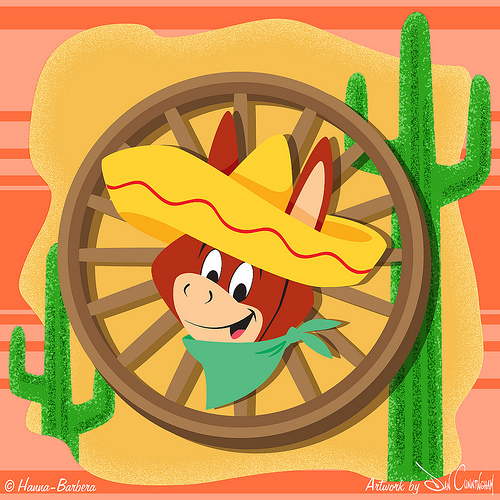
Equine hero and part-time sheriff, Quick Draw McGraw roamed the wild west righting wrongs. When posing as his heroic alter-ego "El Kabong" Quick Draw donned a Zorro-like outfit, quickly delivering off-key justice by whacking crooks over the head with a guitar, shouting (appropriately enough) "KABONG!"—producing one of Hanna-Barbera's most famous sound effects: a delicious, crunching whack accompanied by a loud guitar twang.

Quick Draw's slow, gangly cowboy drawl was also provided by Daws Butler. Quick Draw McGraw is one of the few Hanna-Barbera characters that was not directly based on a celebrity or real-life personality.

Artwork by Dan Cunningham, ©Hanna-Barbera
Medium: Vector Art in Adobe Illustrator

Diminutive burro Baba Looey was Quick Draw's loyal sidekick, with a name derived from the popular signature song "Babalu" by Desi Arnaz of I Love Lucy fame. Baba Looey's hero worship forever helped get his life-long pal "Queekstraw" out of jams when battling cattle-rustlers, bank robbers or saving damsels in distress. He may be best-known, however, as the impetus for the nickname of Howard Stern's long-suffering radio producer Gary "Baba Booey" Dell'Abate. Baba Looey's high-pitched Latino accent was also provided by Daws Butler.

There will be more to come in this series, and perhaps we'll dig further into H-B stories as we go along. If you're anything like me, and enjoy animation and Hanna-Barbera history, there's a blogger with two sites with some outstanding posts. So seeped in Hanna-Barbera knowledge are they, that BOTH blogs are named after H-B canines (of which there are many*)...


YOWP centers on the theme of what this series of illustrations: fascinating minutiae on the earliest Hanna-Barbera TV cartoons. Detailed notes on the music, creative talent, promotional materials, shows and individual shorts the likes of remain unmatched anywhere else.
 

TRALFAZ expands the introspection to many different animation studios, both TV and theatrical. If you are interested in the creative personalities and techniques involved in the production of animated productions, this blog is required reading. There's even a bit of cross-pollination with old time radio and Hollywood personalities—after all, many stars lent their voices to animation, or allowed themselves to be caricatured both visually and vocally.

Be sure to go check 'em out, and check back here in the coming weeks for more "smarter than the a-a-aver-age fun."**
* Joe Barbera was notorious for sticking dog characters into the cartoon casts, especially after he learned a particular TV executive was keen on any show featuring dogs. For the record, Yowp is the small white hound featured in 3 different H-B shorts, as a hunting/tracking dog, known for his low, repeating bark of "yowp-yowp-yowp"—perhaps even more obscure, Tralfaz was the original name of the Jetsons family dog bestowed upon him by his wealthy first owner in the 1962 episode Millionaire Astro. Both dogs were voiced by Don Messick, who provided vocals for nearly every Hanna-Barbera dog, including their most famous pooch: Scooby-Doo.
** If you hang around me long enough, it's pretty likely I'll toss out a quick line as a character voiced by Daws Butler, then act like it never happened.

Friday, September 14, 2012

See You in Disneyland #3: Wally Boag as Pecos Bill

"See You in Disneyland: Wally Boag as Pecos Bill"
Artwork by Dan Cunningham, © The Walt Disney Company
Medium: Vector Art in Adobe Illustrator

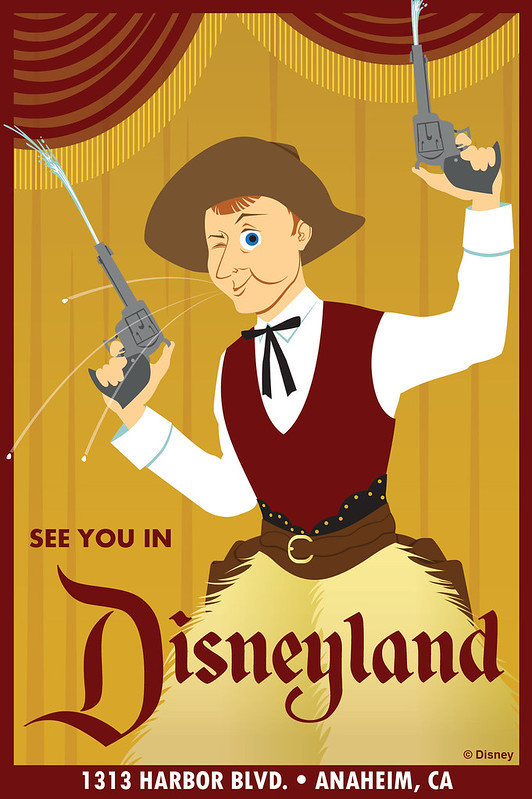
As promised in the 8/10/12 post, we're celebrating the wild antics of Wally Boag: "that loud, long, lean, loquacious, lunatic who likes to deal, delve and dabble in delirious dialogue and dynamic dissertations." Wally's hilarious long-running performance at the Golden Horseshoe Revue is the focus of the third illustration in my See You in Disneyland series.

The art of human caricature can go through infinite filters, I took some careful consideration on how to depict Wally here, since he was a live performer and the first two entries in See You in Disneyland were sculpted, character-based figures. Because this is part of series, there has to be consistency across the individual illustrations in order for them to be viewed as a whole. To maintain a rigid, human likeness would stray from the style established, while going too far into stylized caricature would cause cartoon-like icons (like the Sea Serpent and Reindeer) to appear more realistic. What's been chosen is a reasonable balance allowing everyone to exist within the same world.

Fulton Burley Chuckles as "Pecos Bill" Takes the Stage
Image courtesy of Gorillas Don't Blog

From Disneyland's opening day in 1955 to 1982, Wally performed several shows daily in the Golden Horseshoe Revue in dual roles for each performance: first appearing as the "Traveling Salesman" where his iconic balloon animals, patter and dancing were featured, followed by a quick change backstage to return as a zany "Pecos Bill" for the Revue's song and dance finale. The "Pecos Bill" routine was a frenetic, upbeat number in which Wally squirted the audience with water pistols, casually doffed his toupee, then spit out uncountable "teeth" (baby lima beans) after getting socked in the jaw by Slue Foot Sue, portrayed by the beautiful Betty Taylor.


Betty and Wally Make 'Em Laugh
Image courtesy of www.yesterland.com

The original Golden Horseshoe Revue show ran from 1955 1986: a remarkable 31 years presented by a seasoned group of regular performers. During this span, the original show ran over 50,000 times and is listed in the Guinness Book of Records as the longest-running musical of all time! Despite banking thousands of performances, the cast made each show seem fresh, fun and spontaneous as though it were their first.

Wally Boag's comic persona and one-of-a-kind balloon animal act immediately became a favorite of Walt Disney himselfWalt never failed to bring important guests and dignitaries to get a box seat and watch Wally gambol across the boards of the Horseshoe. In fact, Wally Boag inspired many several young Disneyland employees to take up comedy as a careerincluding a young man named Steve Martin, who regularly cites Wally as the main inspiration for his stage and stand-up persona.

 Wally Boag and Steve Martin at Disneyland in 2005
Image courtesy of www.fitfabceleb.com

You'll see more here on the Golden Horseshoe down the line, we'll return to pay tribute to our lovely leading lady and ebullient Irish Tenor. The Golden Horseshoe Revue remains a favorite to many and will always be an important part of Disneyland history. In the meantime, here are some great resource to discover more about the show and its legacy:
Wally Boag: Clown Prince of Disneyland by Wally Boag and Gene Sands
Image courtesy of www.yesterland.com

There's more See You in Disneyland to come, too... next in the series, we'll travel deep into the wilds of Adventureland!